
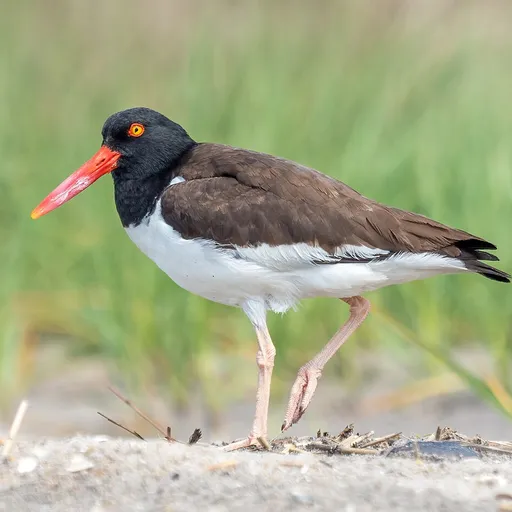
American Oystercatcher
Haematopus palliatus
Least Concern
Overview
The American oystercatcher, or Haematopus palliatus, is a member of the family Haematopodidae known for its striking black and white plumage. The species was originally called the "sea pie" before being renamed in 1731 after the observation of the bird consuming oysters.
Identification
- Distinctive black and white plumage with a black head and breast, greyish-black back, wings, and tail, and white underparts.
- Long, bright orange beak that is heavy and used for prying open shells.
- Yellow irises with orange orbital rings and pink legs.
- Adults measure between 42–52 cm (17–20 in) in length.
Habitat
Found on the Atlantic coast of North America from coastal Massachusetts to northern Florida, as well as on the Gulf Coast, Caribbean, and south to Brazil, Uruguay, and Argentina, and along the Pacific coast of California, Mexico, Central America, Peru, and Chile. Breeding occurs in coastal habitats such as sand or shell beaches, dunes, salt marshes, and mudflats, while wintering flocks feed in tidal mud and salt flats.
Diet
Feeds almost exclusively on shellfish and other marine invertebrates, including oysters, mussels, clams, limpets, sea urchins, starfish, crabs, and worms. The bird uses its large bill to catch shellfish, often jabbing into partially opened shells to sever the adductor muscle, or by hammering loose shells and probing sand for soft-bodied prey.
Did you know?
The bird carries the risk of being drowned if it fails to completely sever the adductor muscle of a mollusk, leaving the bird trapped by the clamping shell until the tide rises.
Sources
- Wikipedia · CC BY-SA 4.0
- Wikidata · CC0 1.0