
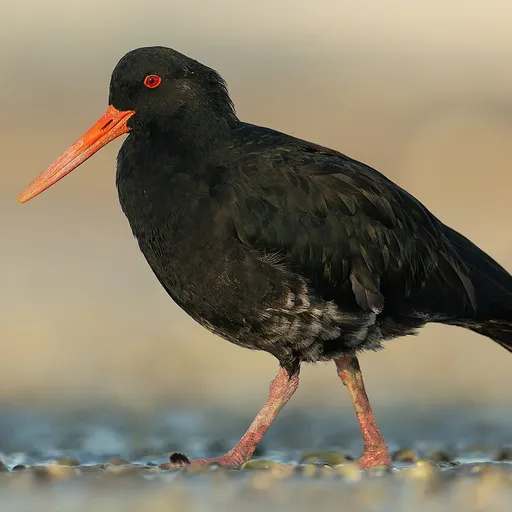
Variable Oystercatcher
Haematopus unicolor
Least Concern
Listen
XC665865 · craig wilson · North West Bay, Marlborough District, Marlborough, New Zealand · CC BY 4.0
Overview
The Haematopus unicolor, also known as the red bill, is a sedentary wader endemic to New Zealand. As a species of least concern, it is currently noted to be in acceptable ecological health with a population estimated between 4,000 and 5,000 individuals.
Identification
- Plumage: Highly variable, ranging from pied (black and white) to mottled or completely black, with a smaller white rump patch compared to the South Island pied oystercatcher.
- Bill: Orange-red and needle-shaped; the bill darkens to a deep red during the breeding season.
- Legs: Pink legs, accompanied by an orange eye ring.
- Size: 42 to 47 cm in length with a short, sturdy body and thick neck; males weigh approximately 678 g and females slightly more at around 724 g.
Habitat
Found around most of the North, South and Stewart Islands coastlines, as well as some offshore islands, but typically never more than 30 km from the coast. They prefer sandy coastal areas, beaches and estuaries, while avoiding gravel beaches and boulder strewn areas. Nesting occurs on sandy coasts, sand dunes or between rocks, often using scrapes lined with seaweed.
Diet
Feeding is diurnal and nocturnal, stopping only during high tide, with food located mainly by sight or by random probing in the dark. The diet consists of molluscs, crustaceans, worms and small invertebrates, which are opened by stabbing, twisting or hammering with the bill. After heavy rain, birds may go inland to forage for earthworms.
Did you know?
A tapeworm discovered in a bird in Tasman Bay was the first instance of a wild bird species ever contracting a tapeworm. This specific parasite, Taenia increscens, is found exclusively in variable oystercatchers.
Sources
- Wikipedia · CC BY-SA 4.0
- Wikidata · CC0 1.0