
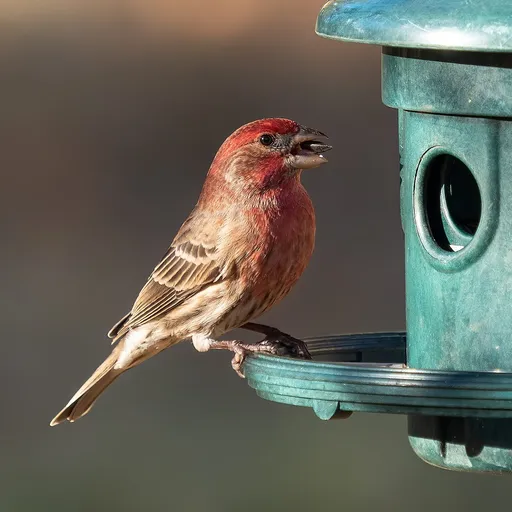
House Finch
Haemorhous mexicanus
Least Concern
Listen
XC964189 · steve · El Refugio, Los Cabos, Baja California Sur, Mexico · CC BY-SA 4.0
Overview
The house finch (Haemorhous mexicanus) is a North American bird in the finch family, native to Mexico and the southwestern United States. It has since been introduced to eastern North America and Hawaiʻi, where it is now found year-round across most of the continent, including breeding grounds in northern Canada.
Identification
- Size and Structure: A moderate-sized finch measuring 12.5 to 15 cm in length, with a wingspan of 20 to 25 cm and a body mass averaging 21 g. It possesses a long, square-tipped brown tail and a short, thick bill with a culmen length of 0.9 to 1.1 cm.
- Plumage: Adults are generally brown or dull-brown on the back, often shading into deep gray on the wings, with streaked breasts and bellies. Adult males typically have reddish heads, necks and shoulders, with color intensity ranging from pale straw-yellow to deep red depending on diet, while females retain brown upperparts and streaked underparts.
- Vocalisations: Songs consist of high-pitched musical jumbles ending in a distinct high note or wheer. Flight calls include a soft cheet or wheat, while perched birds produce a more drawn-out version of this call.
Habitat
Breeding habitats include urban and suburban areas across North America, as well as various semi-open regions in the west stretching from southern Canada to Oaxaca in Mexico. The species is mainly permanent throughout its range, although some individuals migrate south, with adult females travelling longer distances than males.
Diet
House finches primarily consume grains, seeds and berries, acting as voracious eaters of weed seeds such as nettle and dandelion, alongside incidental small insects like aphids. They forage on the ground or in vegetation and are frequent visitors to bird feeders, particularly those stocked with sunflower or nyjer seed, where they may congregate at hanging socks.
Did you know?
Unlike most birds that provide animal matter to nestlings for protein, house finches are among the few species that feed their young exclusively plant matter. Additionally, female finches may lay female eggs first in response to mite infestations, as these parasites have a more deleterious effect on male chicks, thereby increasing the likelihood that representative numbers of both sexes survive.
Sources
- Wikipedia · CC BY-SA 4.0
- Wikidata · CC0 1.0