
Blue-lored Antbird
Hafferia immaculata
Least Concern
Overview
The blue-lored antbird (Hafferia immaculata) is a species of antbird found in the humid evergreen forests of Colombia and Venezuela. It was formerly known as the immaculate antbird before a taxonomic rearrangement in 2013 moved it to the genus Hafferia to create monophyletic groups. The species is currently assessed as Least Concern by the IUCN, although its population is believed to be decreasing.
Identification
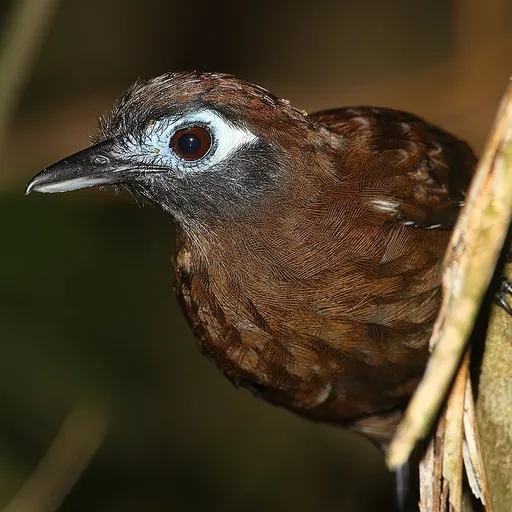
- Males of the nominate subspecies are mostly very dark gray with a hidden white line at the wing bend, while females feature dark reddish brown upperparts and a blackish tail.
- Both sexes possess distinctive pale blue lores, a ring of bare pale blue skin around the eye, and a deep red iris.
- The species measures 18 to 19 cm in length and weighs approximately 39 to 44 g.
- The song of the nominate subspecies consists of long, evenly paced, slightly downslurred whistles of the same pitch that shorten slightly, while calls include a short rising and falling 'tweet' and a one-second rattle.
Habitat
The blue-lored antbird inhabits the understorey and edges of humid evergreen forest and mature secondary forest, primarily in regenerating landslides and tree-falls on steep hillsides and ravines. It has a disjunct distribution across the Andes of Colombia and Venezuela, ranging in elevation from 500 to 2,100 m in Colombia and 900 to 1,700 m in Venezuela.
Diet
This bird feeds on a variety of insects, other arthropods, and probably small vertebrates. It typically forages singly, in pairs, or in family groups by hopping between short feeding stops in dense vegetation near the ground, often following army ant swarms to capture fleeing prey.
Did you know?
The species was previously classified as the immaculate antbird and included what is now Zeledon's antbird as a subspecies, but was separated following a 2013 molecular phylogenetic study that revealed its former genus was polyphyletic.
Sources
- Wikipedia · CC BY-SA 4.0
- Wikidata · CC0 1.0