
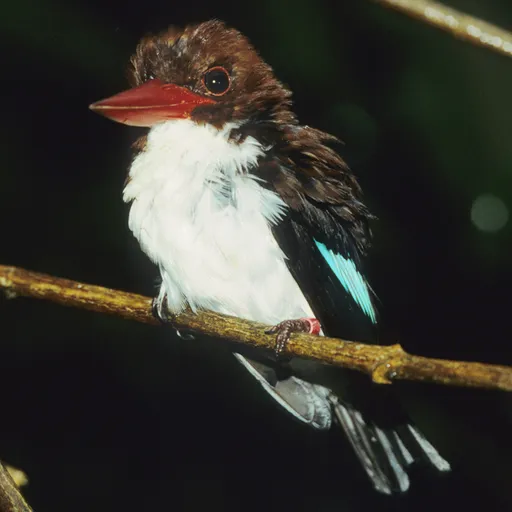
Chocolate-backed Kingfisher
Halcyon badia
Least Concern
Overview
The chocolate-backed kingfisher (Halcyon badia) is a species of kingfisher native to the African tropical rainforest. It is currently classified as Least Concern on the IUCN Red List. Unlike many of its relatives, this species is not associated with water and inhabits primary and secondary lowland rain forests.
Identification
- Stocky build with very dark brown head and hind neck, brownish-black mantle, and a brilliant iridescent blue rump.
- Pure white underparts with a small blackish flank patch, clearly demarcated from the dark upper parts.
- Red or reddish-brown bill in adults; juveniles have a blackish bill with an orange tip and scalloped breasts.
- Brilliant azure speculum on the wings and pale blue tail are distinctive in flight.
Habitat
This bird resides in primary and secondary lowland rain forests across the African tropics. Its range extends from Sierra Leone to Ghana, and from southern Nigeria east to southern Central African Republic and western Uganda, south to the Kwango River in northern Angola, as well as on Bioko island.
Diet
The chocolate-backed kingfisher feeds on insects, mainly grasshoppers and beetles, other invertebrates, and small lizards. It typically perches quietly high in trees overlooking a clearing to catch prey in the air or drop onto it on the ground, and has been recorded attacking columns of driver ants.
Did you know?
The bird excavates its nest horizontally into the earth nests of arboreal termites of the genus Nasutitermes, which are often fixed to vines or branches 4–5 m above the forest floor. The termites respond to the intrusion by sealing themselves off from the cavity created by the birds.
Sources
- Wikipedia · CC BY-SA 4.0
- Wikidata · CC0 1.0