
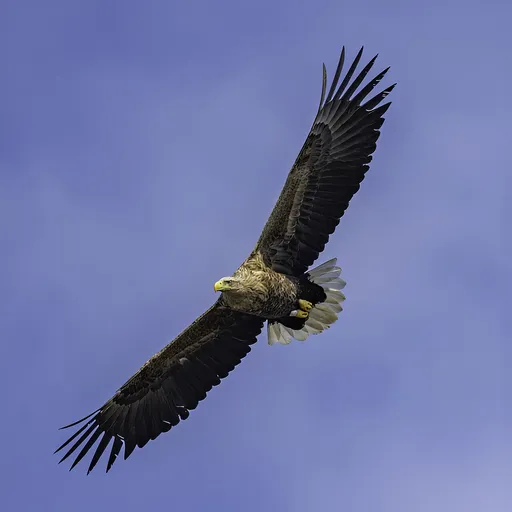
White-tailed Eagle
Haliaeetus albicilla
Least Concern
Overview
The white-tailed eagle (Haliaeetus albicilla), also known as the sea eagle, is a large bird of prey widely distributed across temperate Eurasia. It is a member of the family Accipitridae and is currently listed as Least Concern on the IUCN Red List.
Identification
- Overall greyish mid-brown plumage with a distinctly paler, buff-coloured head, neck, and upper breast in adults.
- One of the largest living birds of prey, measuring 66 to 94 cm in length with a wingspan typically ranging from 1.78 to 2.45 m.
- Features a large exposed culmen (45 to 65 mm) and a sharply curved hallux claw, the largest of any accipitrid, adapted for gripping slippery prey.
- Juveniles are often of similar weight to adults but possess somewhat larger average wing and tail lengths.
Habitat
Widely distributed across temperate Eurasia, breeding from Greenland and Iceland in the west to Hokkaido, Japan, in the east. It lives most of the year near large bodies of open water, including coastal saltwater areas, inland freshwater lakes, wetlands, bogs, and rivers, requiring old-growth trees or sea cliffs for nesting.
Diet
As a powerful apex predator and opportunistic scavenger, it feeds primarily on an abundant supply of fish and birds, largely water birds. Its sharply curved hallux claw is specifically adapted to prevent the escape of slippery prey such as fish.
Did you know?
An ancient DNA study revealed that a sea eagle skeleton found in a lava cave on Maui likely represented an isolated, resident population in the Hawaiian archipelago for more than 100,000 years, where it was the largest terrestrial predator.
Sources
- Wikipedia · CC BY-SA 4.0
- Wikidata · CC0 1.0