
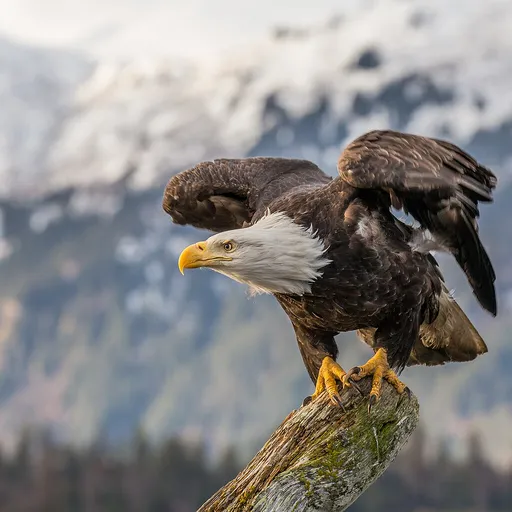
Bald Eagle
Haliaeetus leucocephalus
Least Concern
Listen
XC1163370 · Rachel Thurman · Riverside Rotary Park (near Juneau), Juneau City and Borough, Alaska, United States · CC BY 4.0
Overview
The bald eagle (Haliaeetus leucocephalus) is a sea eagle and bird of prey found in North America, recognised as the national bird of the United States. It is an opportunistic feeder that subsists mainly on fish, often swooping down to snatch prey from the water with its talons.
Identification
- Adult plumage is evenly dark brown with a distinctive white head and tail, whereas immatures are dark brown with messy white streaking.
- Females are approximately 25% larger than males, with body lengths ranging from 70 to 102 cm and wingspans between 1.8 and 2.3 m.
- Possesses a large, hooked yellow beak with a yellow cere, along with bright yellow feet, irises, and large, powerful talons.
- The call consists of weak staccato, chirping whistles (described as 'kleek kik ik ik ik'), resembling a gull's call, with young birds producing harsher and shriller sounds than adults.
Habitat
Found in most of Canada, all of the contiguous United States, and northern Mexico, the species typically resides near large bodies of open water such as seacoasts, rivers, and lakes that provide an abundant food supply. It requires old-growth or mature coniferous and hardwood trees for nesting, often selecting sites with minimal human disturbance, though it will occasionally nest in major cities or near reservoirs.
Diet
An opportunistic feeder that subsists mainly on fish, which it snatches from the water by swooping down and grasping them with its talons. The highly developed talon of the hind toe is specifically used to pierce the vital areas of prey while it is held immobile by the front toes.
Did you know?
Despite its common name, the bald eagle is not literally bald; the name derives from an older usage of the word 'bald' meaning 'having white on the face or head', referring to the white feathers of the adult. The species builds the largest tree nests ever recorded for any animal species, with some reaching 2.5 m wide, 4 m deep, and weighing up to 1 metric ton.
Sources
- Wikipedia · CC BY-SA 4.0
- Wikidata · CC0 1.0