
Steller's Sea Eagle
Haliaeetus pelagicus
Vulnerable
Overview
Steller's sea eagle (Haliaeetus pelagicus) is a very large diurnal bird of prey that is typically the heaviest eagle in the world. It is a glacial relict species endemic to coastal northeastern Asia and is currently listed as vulnerable on the IUCN Red List.
Identification
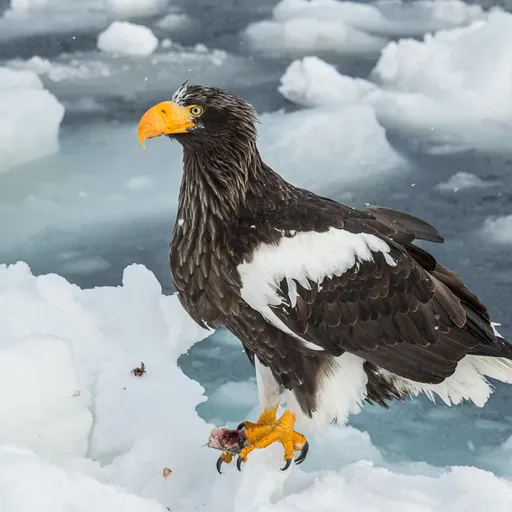
- Mature birds display dark brown to black plumage with strongly contrasting white on the wings, tail, and thighs, while juveniles are largely uniform dark soot-brown with light mottling.
- Possesses the largest bill of any living eagle, which is yellow even in juvenile birds, along with yellow eyes and talons.
- Distinguished by a diamond-shaped tail and paddle-like wings, contrasting with the square-looking wings of similar species.
- Vocalisations include deep barking cries and honking calls similar to those of Canada geese.
Habitat
The species breeds in Russia, including the Kamchatka Peninsula, the Sea of Okhotsk coast, and the Amur River region, with many individuals migrating to Korea, Japan, and China for the winter. Nests are constructed on large rocky outcroppings or at the tops of trees in coastal and riverine habitats featuring mature larches, alders, and Erman's birches.
Diet
As an apex predator, it feeds primarily on fish, favouring salmon and trout in river habitats and species such as Bering wolffish and lumpfish in coastal areas. Hunting is conducted almost exclusively in shallow water, and in autumn, dead fish that die after spawning are frequently consumed.
Did you know?
A single individual nicknamed 'Stella' traversed the Pacific Ocean to reach North America, where it was observed in Newfoundland and reportedly engaged in nesting behaviour while displaying aggression towards nearby bald eagles.
Sources
- Wikipedia · CC BY-SA 4.0
- Wikidata · CC0 1.0