
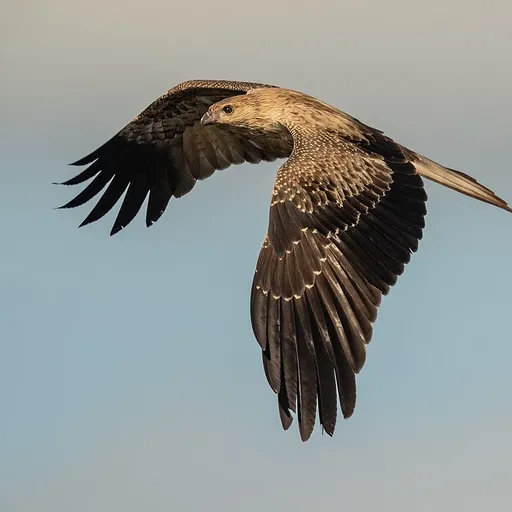
Whistling Kite
Haliastur sphenurus
Least Concern
Overview
The whistling kite (Haliastur sphenurus) is a medium-sized diurnal raptor found throughout Australia, New Caledonia, and parts of New Guinea. It is also known as the whistling eagle or whistling hawk and is currently listed as Least Concern on the IUCN Red List.
Identification
- Size: 50 to 60 cm in length with a wingspan of 123 to 146 cm; females are significantly larger and heavier than males.
- Plumage: Adults are pale buff on the head, breast, and tail with browner wings and black flight feathers; immatures are heavily streaked reddish-brown with prominent pale wing spots.
- Structure: Distinctive small-headed and long-tailed appearance with bone-colored, unfeathered legs that fall well short of the tail tip when perched.
- Voice: Loud and noisy, characterised by a clear descending whistle often followed by a rapid series of rising notes.
Habitat
Typically found in open or lightly wooded areas near water, ranging from sea level to 1,400 meters elevation. While generally sedentary, some Australian populations are nomadic or migrate seasonally, particularly in southern regions. Local declines in southern Australia have been linked to wetland drainage and reduced food supplies.
Diet
An indiscriminate feeder that consumes small mammals, birds, fish, reptiles, amphibians, crustaceans, insects, and carrion. Australian birds primarily take live prey except in winter, whereas New Guinean populations are principally scavengers. They forage from the ground or water surface, hover over grass fires to catch fleeing prey, and may even carry burning sticks to spread flames.
Did you know?
The whistling kite is one of only three bird species known to intentionally set or spread fires to catch prey, alongside the black kite and brown falcon. Additionally, spotted bowerbirds have been observed to regularly mimic the whistling kite's calls, with the frequency of this mimicry increasing as the bowerbird breeding season progresses.
Sources
- Wikipedia · CC BY-SA 4.0
- Wikidata · CC0 1.0