
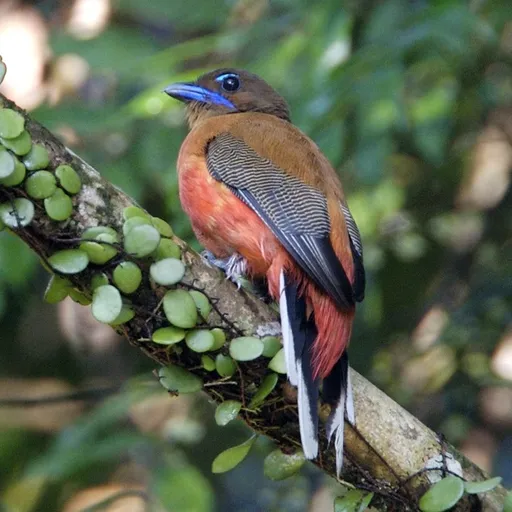
Scarlet-rumped Trogon
Harpactes duvaucelii
Near Threatened
Overview
The scarlet-rumped trogon (Harpactes duvaucelii) is the world's smallest trogon, also known as Duvaucel's trogon or the red-rumped trogon. Classified as Near Threatened by the IUCN, this solitary bird is found in the lowland forests of Southeast Asia, where it is the most common Sundaic trogon in many regions.
Identification
- Size: The smallest trogon in the world, with adults measuring 23–24 cm in length and weighing 34–43 g.
- Plumage: Males feature a black head, red underparts and rump, and buff upperparts; females and juveniles are duller, with buffy-brown breasts and reddish-pink or rufous bellies.
- Markings: Both sexes possess a blue bill, eyebrow, and thin eye ring, with white and black-bordered tail undersides.
- Song: Males emit twelve short, rapid 'yau' notes that accelerate, while alarm calls resemble the whirring of a scolding squirrel.
Habitat
This species inhabits the middle and sometimes lower storeys of lowland semi-evergreen and evergreen forests, including freshwater swamp forests, in lowlands and hills across southern Thailand, southern Myanmar, the Malay Peninsula, Sumatra, Borneo, and various islands. It favours areas with lianas but avoids mangroves, cultivated areas, and open country, with altitude ranges varying from near sea level up to 1,500 m on Mount Kinabalu.
Diet
The diet consists primarily of invertebrates such as moths, beetles, stick insects, and caterpillars, along with fruit and small vertebrates. It is a still-hunting predator that waits on branches in the middle storeys before rushing at prey on other surfaces or in the air, and sometimes rests at the edge of cleared areas to swoop in similarly to shrikes.
Did you know?
Once perched, the bird is physically unable to walk or turn around because of highly reduced leg muscles, forcing it to use its wings to adjust its position.
Sources
- Wikipedia · CC BY-SA 4.0
- Wikidata · CC0 1.0