
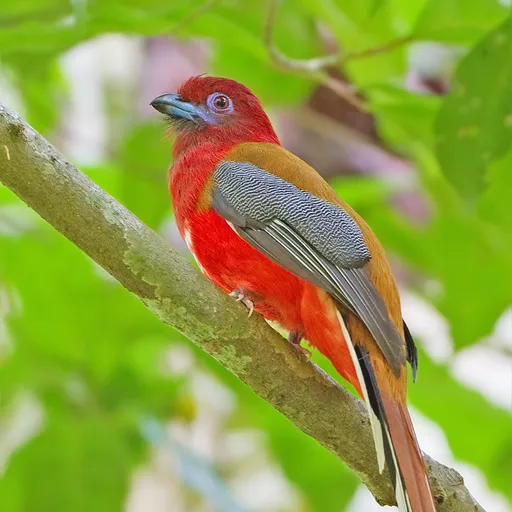
Red-headed Trogon
Harpactes erythrocephalus
Least Concern
Overview
The red-headed trogon (Harpactes erythrocephalus) is a species of bird in the family Trogonidae, widely distributed from central Nepal through Southeast Asia to Sumatra. The species is currently listed as Least Concern on the IUCN Red List.
Identification
- Males possess a dull crimson head, neck, and upper breast, while females have an olive-brown head, making the male's red head a unique feature within the trogon group.
- Both sexes display a narrow white band across the mid-breast, situated above a light red to pink lower breast and abdomen.
- Adults have a long tail with dark brown central feathers tipped in black, black second and third pairs, and white outer pairs with black bases.
- Males exhibit a black-tipped cobalt blue bill and reddish-brown irises, whereas females have a pale blue bill and bare eyering.
- The male's call consists of a sequence of five to six mellow 'tyaup' notes repeated every minute, sometimes accompanied by an extended 'pluu-du' note with a terminal pitch drop.
Habitat
This species prefers dense upland forests, inhabiting broadleaved evergreen forests in tropical and subtropical zones as well as bamboo and oak forests in Myanmar. In Southeast Asia, it typically occupies elevations ranging from 300 to 2,600 m, though it can be found as low as 300 m on the Malay Peninsula. It is generally sedentary but may migrate between different elevations in parts of Laos.
Diet
The red-headed trogon feeds primarily on insects and their larvae, including green orthopterans, stick-insects, cicadas, millipedes, flies, beetles, centipedes, woodlice, and moths. It also consumes leaves and fruits, often foraging by perching on shaded branches or following flocks of birds to exploit flushed insects.
Did you know?
Although generally sedentary, the species has been observed migrating between different elevations in northern and southern Laos. Its flight between trees is notably sluggish and very low, often passing only a few meters above the ground.
Sources
- Wikipedia · CC BY-SA 4.0
- Wikidata · CC0 1.0