
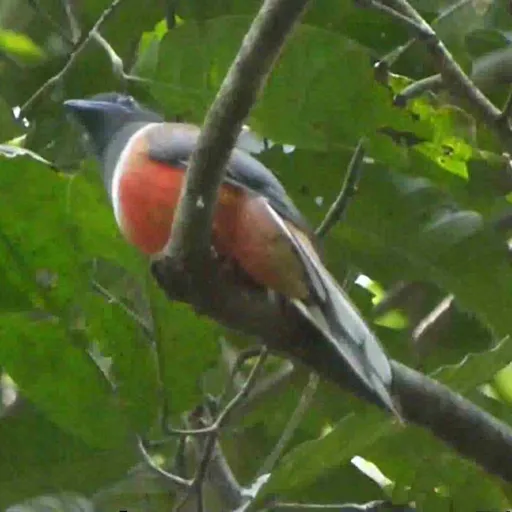
Malabar Trogon
Harpactes fasciatus
Least Concern
Overview
The Malabar trogon (Harpactes fasciatus) is a brightly coloured, sexually dimorphic species of bird in the trogon family, listed as Least Concern by the IUCN. It inhabits the forests of India and Sri Lanka, although it is becoming rarer in some parts of India and is thought to be sensitive to forest fragmentation.
Identification
- Males feature a slaty-black head and breast with a white-bordered bib, contrasting with a crimson underside, while the female has a slightly darker head and breast shading into olive-brown with an ochre underside.
- Both sexes possess a bluish bill and pale blue feet, with dark brown irises and nostrils covered by tufts of filoplumes.
- The feet are heterodactyl, a feature unique to trogons, with the first and second digits facing backward and the third and fourth pointing forward.
- They utter low, guttural calls that are audible only at close quarters and often perch still, sometimes facing away from the viewer, making them easy to miss despite their colourful plumage.
Habitat
Found in the forests of India and Sri Lanka, in India it is mainly located in the Western Ghats, hill forests of central India, and parts of the Eastern Ghats. In the Nilgiri hills, they act as altitudinal migrants, appearing in higher reaches only during summer. In Sri Lanka, they are often found in mixed-species foraging flocks.
Diet
Malabar trogons feed exclusively on insects, though seeds have been reported in the diet of Sri Lankan specimens. They forage mainly at 5 to 10 m above the ground, sometimes descending to search for insects under leaf litter or hanging upside down to reach prey on vertical tree surfaces. Prey is often mashed or struck on a branch between the mandibles before consumption.
Did you know?
The birds' feet are heterodactyl, a configuration unique to trogons where the first and second digits face back while the third and fourth point forward, which is distinct from the zygodactyl arrangement found in other birds. Sri Lankan individuals have also been observed plunging into water from overhanging branches to bathe.
Sources
- Wikipedia · CC BY-SA 4.0
- Wikidata · CC0 1.0