
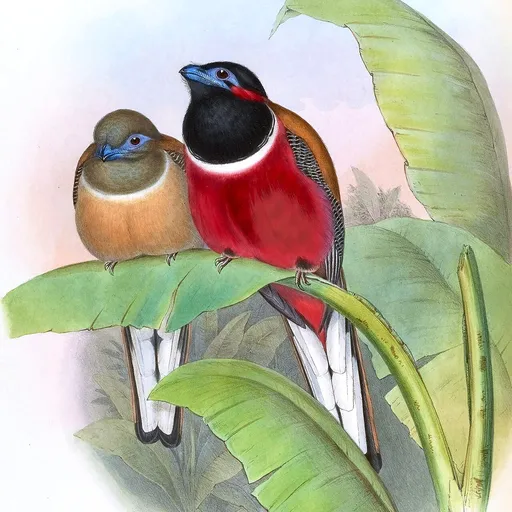
Red-naped Trogon
Harpactes kasumba
Near Threatened
Overview
The red-naped trogon (Harpactes kasumba) is a bird in the family Trogonidae found in Brunei, Indonesia, Malaysia, and Thailand. Classified as Near Threatened by the IUCN, the species is a sedentary resident of the Sundaic lowlands and is currently facing a moderately rapid population decline due to habitat loss.
Identification
- Males feature a black head and upper breast with a bright blue face and bill, yellow-brown upperparts, and bright red underparts, distinguished by a band of red feathers around the back of the head.
- Females are duller than males, possessing a grey-brown head and upper breast with yellow underparts.
- Both sexes measure up to 32 cm in height with compact bodies, short wings, and long tails.
- The song is a slow, sad-sounding series of five to eight notes described as 'pau pau pau pau pau,' delivered at approximately one note per second.
Habitat
This species inhabits subtropical or tropical moist lowland forests, primarily in primary or lightly logged evergreen forests below 600 metres, though it occasionally reaches 1,200 metres in Borneo. It is also recorded in peat-swamp forests, thick bamboo groves, and some logged areas, plantations, and coconut or cocoa farms. Its distribution covers the Sundaic lowlands, including the Malay Peninsula, Borneo, Java, and Sumatra.
Diet
Mainly insectivorous, the red-naped trogon prefers stick insects and spiders, supplementing its diet with small lizards, fruits, and seeds. It forages using sally-glean flight, flying from an observation perch to snatch prey from another perch or foliage before hovering to secure the item. Its serrated beak and decurved bill tip aid in securing live prey and cutting food into smaller pieces.
Did you know?
The ratio of leg muscle to body weight in trogons is only 3%, the lowest known ratio of any bird, rendering the red-naped trogon unable to turn around on a branch without the aid of its wings.
Sources
- Wikipedia · CC BY-SA 4.0
- Wikidata · CC0 1.0