
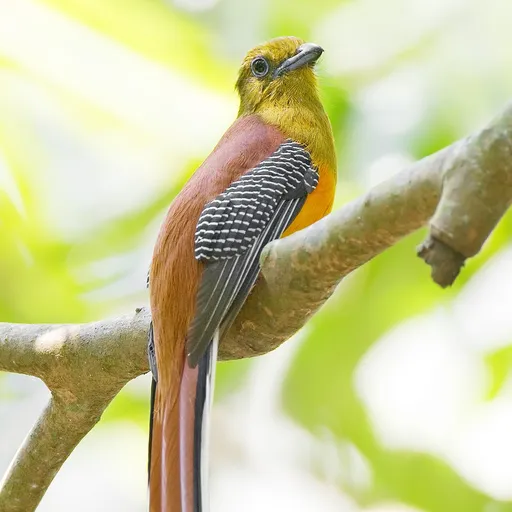
Orange-breasted Trogon
Harpactes oreskios
Least Concern
Overview
The Harpactes oreskios is a colourful, sedentary species of bird in the family Trogonidae. It is native to the lower canopy of lowland and montane forests in southern China and Southeast Asia, including Borneo, Sumatra, and Java.
Identification
- Medium-sized bird measuring 25–31 cm in length and weighing 49–57 g.
- Males possess a dull olive-yellow head, rufous-chestnut upperparts, and a yellow-orange lower breast, whereas females have grey-brown upperparts and a grey breast with yellow at the belly.
- A distinct blue eye ring is present, and both sexes have grey feet with two toes pointing backwards.
- Song typically begins with 1–3 notes of 'to (to to)' followed by 3–4 even-pitched 'tau-tau-tau'.
Habitat
Inhabits subtropical or tropical moist lowland and montane forests, including swampy, bamboo, and open dry forests, as well as clumps of trees near forests. Range extends from southern China through Laos, Thailand, peninsular Malaysia, Borneo, Sumatra, Java, and Nias, with varying elevations depending on the location.
Diet
This insectivorous species uses the 'sally-stall' technique, pursuing prey from a perch and stalling before seizing it. Foraging occurs most commonly at a height of about 9.5 m, with a range of 4.3–13.7 m. Diet comprises various arthropods, including Phasmatodea, Orthoptera, and Lepidoptera larvae.
Did you know?
The orange-breasted trogon breeds outside the peak availability period for its food items, likely to avoid competition with the larger red-headed trogon for food.
Sources
- Wikipedia · CC BY-SA 4.0
- Wikidata · CC0 1.0