
Ward's Trogon
Harpactes wardi
Least Concern
Overview
Ward's trogon (Harpactes wardi) is a species of bird in the family Trogonidae found across the northeastern Indian subcontinent and into Southeast Asia. Although it was previously categorised as Near Threatened, it is currently listed as Least Concern due to its large range and slow rate of population decline.
Identification
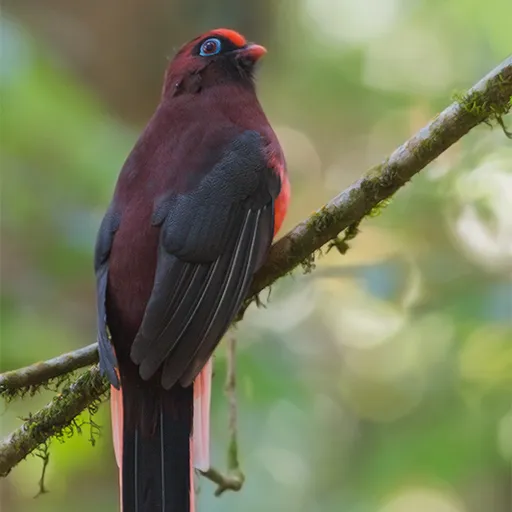
- Males possess a pink-red breast, belly, undertail and forehead, contrasting with dark slate chest, back, wings and uppertail that have a maroon wash.
- Females share the male's pattern but display yellow instead of red, with dark olive replacing the dark slate areas.
- Both sexes feature a blue ring around the eye, while males have a deep red bill tip and females have a yellow one.
- The bird measures 35 to 38 cm in length and weighs between 115 and 120 g.
Habitat
The species is generally montane, typically occupying altitudes between 1,500 and 3,200 m, though it occasionally descends to as low as 300 m, possibly in winter. It inhabits subtropical hill forests dominated by Quercus and Castanopsis, as well as temperate broadleaf evergreen forests. Within these environments, it is usually found in the understory, undergrowth and bamboo stands.
Diet
Ward's trogon feeds on insects such as moths, stick-insects, grasshoppers and bugs, as well as large seeds. Specific details regarding its foraging techniques or nesting behaviour remain unknown, as its nests have not been found or described.
Did you know?
The bird is named after the English botanist and explorer Francis Kingdon-Ward, who also lent his name to Kingduard's partridge and Kingduard's pheasant.
Sources
- Wikipedia · CC BY-SA 4.0
- Wikidata · CC0 1.0