
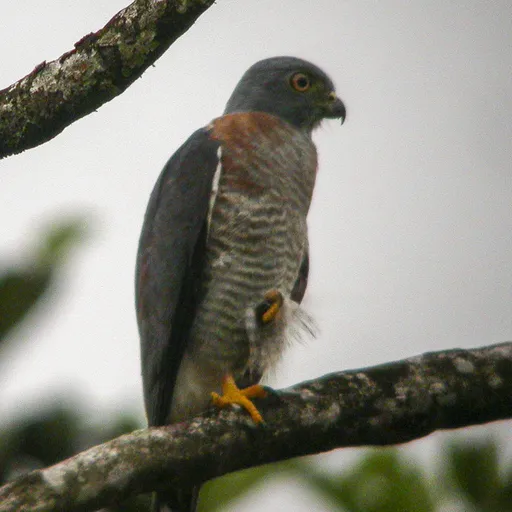
Double-toothed Kite
Harpagus bidentatus
Least Concern
Overview
The double-toothed kite (Harpagus bidentatus) is a species of bird of prey in the subfamily Accipitrinae, commonly known as the 'true' hawks. Despite its name, it is not closely related to other kites but rather to hawks within the family Accipitridae. The species is classified as Least Concern by the IUCN due to its extensive range and large population.
Identification
- 29 to 35 cm in length with a wingspan of 60 to 72 cm, and tooth-like notches on the edge of the maxilla that give the species its name.
- Adult plumage features a dark gray head with a white throat marked by a central dark stripe, lighter gray upperparts, and a blackish tail with three grayish bands and a gray tip; the nominate subspecies has a rufous breast and belly with gray and whitish barring, while H. b. fasciatus shows paler and less extensive rufous with heavier barring.
- Distinctive red eyes, greenish-yellow cere, and yellow legs and feet; immatures are deep brown above with whitish or buff underparts bearing bold vertical brown streaks.
- Vocalizations include high-pitched calls such as 'tsip-tsip-tsip-tsip-wheeeeeoooip' or 'cheeeeee-it' during nest defence, and whistled contact calls like 'see-weeeeep' or 'chee-weet' between pairs.
Habitat
The species ranges from central Mexico through Central America into much of northern and eastern South America, with two subspecies: the nominate H. b. bidentatus found in eastern Colombia, Venezuela, the Guianas, and Amazonian South America, and H. b. fasciatus ranging from Mexico through Central America to western Colombia and Ecuador. It primarily inhabits the interior of mature subtropical and tropical forests, though it also occurs less frequently at forest edges, clearings, and disturbed areas. Its elevation range extends from sea level up to 1,200 m in Costa Rica and Colombia, and 2,100 m in Ecuador.
Diet
The double-toothed kite primarily hunts from a perch in the forest interior, diving to capture prey, with about two-thirds of captures taken directly from vegetation, most of the remainder in flight, and a small percentage from the ground. Its diet consists of insects such as butterflies, cicadas, grasshoppers, katydids, crickets, beetles, wasps, caterpillars, and cockroaches, as well as small vertebrates including anoles, geckos, iguanas, bats, birds, rodents, and snakes. It regularly follows troops of monkeys to catch prey flushed by their movements.
Did you know?
The species is essentially sedentary, yet at least one individual has been documented as a vagrant as far north as Texas. Courtship involves display flights above the canopy, with males provisioning females during both courtship and incubation.
Sources
- Wikipedia · CC BY-SA 4.0
- Wikidata · CC0 1.0