
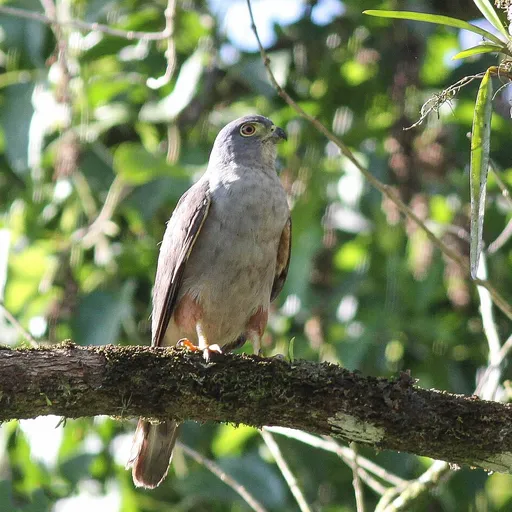
Rufous-thighed Kite
Harpagus diodon
Least Concern
Overview
The rufous-thighed kite (Harpagus diodon) is a species of bird of prey belonging to the subfamily Accipitrinae. It is classified by the IUCN as Least Concern, although its population is believed to be decreasing.
Identification
- Adults have a slate gray head and upperparts, with chestnut thighs that give the species its common name.
- Size ranges from 29 to 35 cm in length with a wingspan of 60 to 70 cm; females are slightly larger than males.
- The tail is slate gray with three paler gray bars and white tips, while the throat is whitish with a dark central streak.
- Eyes are red or orange, the cere is lemon yellow, and legs are yellow to orange.
- Vocalisations include high-pitched 'chee' and disyllabic 'chee-weet' begging calls from fledglings and parents, plus a three-note call from adults.
Habitat
This species primarily inhabits lowland rainforests, favouring primary forest with a closed canopy but also occurring in dense or open secondary forests. Its breeding range includes southern Brazil, northern Argentina, and Paraguay, with regular presence in Amazonian Brazil, Bolivia, Guyana, and Suriname during the non-breeding season.
Diet
The kite hunts within the middle to upper layers of the forest canopy, usually seizing prey from branches rather than in mid-air. Its diet consists mainly of insects such as cicadas and orthoptera, with lesser numbers of small lizards, birds, amphibians, and mammals. It has been observed following army ant swarms and monkey troops to capture prey flushed by them.
Did you know?
Despite its name, the rufous-thighed kite is not closely related to most other kites but to the 'true' hawks. It is a breeding endemic in the Atlantic Forest, a biome that has been almost completely destroyed.
Sources
- Wikipedia · CC BY-SA 4.0
- Wikidata · CC0 1.0