
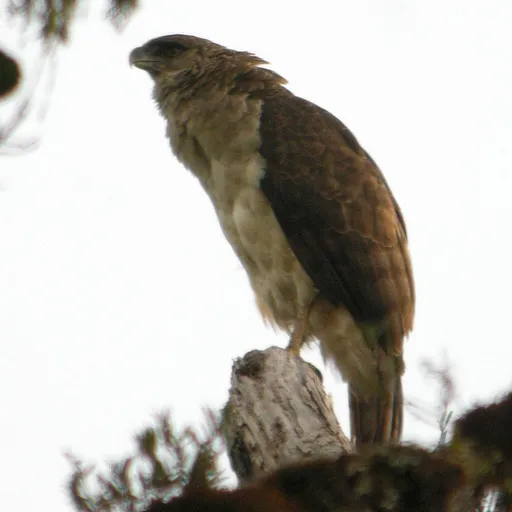
Papuan Eagle
Harpyopsis novaeguineae
Vulnerable
Overview
The Papuan eagle (Harpyopsis novaeguineae) is a large, forest-dwelling bird of prey endemic to New Guinea. Known locally as the kapul eagle, it is a elusive raptor classified as Vulnerable on the IUCN Red List due to habitat destruction and hunting.
Identification
- Adults are greyish-brown with a creamy underside and obscure darker bars, while juveniles are paler with more buff undertail coloration.
- Possesses a prominent head with a short, full crest and a powerful, large black bill and cere.
- Features extremely elongated, bare legs that are brownish-grey to dull orange, giving the bird an upright, bustard-like posture when on the ground.
- Produces a startlingly loud, hiccup-like call described as uumpph or okh, which can carry well through the forest.
Habitat
This species is endemic to New Guinea, found from peninsular Indonesian Papua to throughout the nation of Papua New Guinea. It primarily inhabits undisturbed mature tropical rainforests, though it may occasionally use gallery forests, monsoon scrub, and dry woodland. The eagle is found at elevations from sea level up to regularly 2,000 m, and occasionally as high as 3,700 m.
Diet
The Papuan eagle is an opportunistic predator that feeds mainly on a wide range of mammals, including phalangers, tree-kangaroos, and various rats, as well as birds such as megapodes and hornbills. It hunts by perching inconspicuously in the canopy and gliding down, often using sound to detect terrestrial prey in the undergrowth before dropping or running to catch it. Notably, it is a fast and agile terrestrial predator capable of chasing prey on the forest floor, such as megapodes.
Did you know?
Unique amongst eagles, the Papuan eagle is a surprisingly fast and agile terrestrial avian predator that is capable of chasing down prey on the forest floor. It also possesses one of the longest tarsi of any living eagle, rivaling the much heavier Philippine eagle in this specific proportion.
Sources
- Wikipedia · CC BY-SA 4.0
- Wikidata · CC0 1.0