
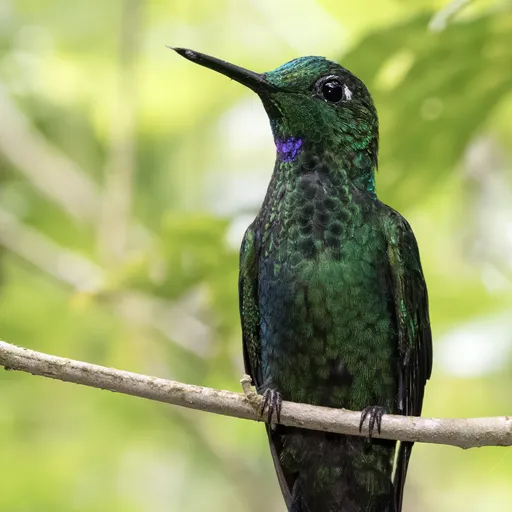
Green-crowned Brilliant
Heliodoxa jacula
Least Concern
Overview
The green-crowned brilliant (Heliodoxa jacula), also known as the green-fronted brilliant, is a species of hummingbird in the tribe Heliantheini. It is classified as Least Concern on the IUCN Red List, although its population is believed to be decreasing.
Identification
- Males are 12 to 13 cm long with a glittering green to blue-green head and a small metallic violet-blue throat patch, while females possess a duller blue-green head and a short white malar stripe.
- Both sexes feature a white spot behind the eye and a forked tail, though the female's tail is less deeply indented than the male's.
- Females have whitish underparts heavily spotted with green, whereas immature males display a dull bronzy green crown and a bright buff chin.
- Vocalisations include a loud and squeaky 'kyew' or 'tyew' call, and displaying males in Costa Rica produce a 'tseek, tseek, tseek' sound.
Habitat
Found across Colombia, Costa Rica, Ecuador, and Panama, the species inhabits a variety of landscapes including the interior, edges, and clearings of humid sub-montane and montane forest, as well as mature secondary forest and gardens. Elevation ranges generally between 700 and 2,200 m in Costa Rica, though records extend as low as 100 m, with slightly different ranges observed in Panama, Colombia, and Ecuador.
Diet
The bird usually forages in the middle and upper strata of the forest, with Marcgravia vines serving as a primary source of nectar, while females also feed at small understory plants. It typically clings to flowers to feed rather than hovering, and males may either defend Marcgravia patches or nectar by trap-lining a circuit of flowering plants.
Did you know?
The female solely incubates two white elliptical eggs laid in a bulky cup of plant fibers and tree fern scales, typically saddled on a thin down-sloping branch between 2 and 6 m above the ground.
Sources
- Wikipedia · CC BY-SA 4.0
- Wikidata · CC0 1.0