
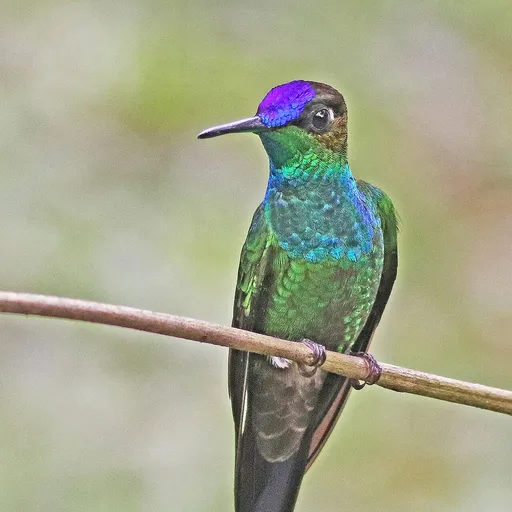
Violet-fronted Brilliant
Heliodoxa leadbeateri
Least Concern
Overview
The violet-fronted brilliant (Heliodoxa leadbeateri) is a species of hummingbird in the tribe Heliantheini. It is a sedentary bird found across several South American countries, ranging from coastal areas to the Andes.
Identification
- Males feature bronzy green upperparts with glittering blue or violet foreheads and coppery necks, while females are coppery green above with white underparts thickly spotted with glittering green.
- Medium-sized bird measuring 11 to 13 cm in length, with a medium-length, almost straight, black bill.
- Distinguished by a white malar streak and a small white spot behind the eye; both sexes possess a forked tail, though it is less deeply indented in females.
- Vocalisations include a continuous series of single strident 'chup' or 'tchep' notes, as well as a repeated, bright, descending phrase resembling a jerky twittering.
Habitat
This species inhabits tropical and subtropical landscapes, primarily occurring in the interior and edges of pre-montane rainforest and cloudforest, though it also frequents scrub, clearings, secondary forest, and coffee plantations. Its elevation range spans between 400 and 2,400 m, covering the Venezuelan Coastal Range, the Andes of Venezuela, Colombia, Ecuador, Peru, and northwestern Bolivia.
Diet
Foraging typically occurs in the lower to middle strata of the forest, usually below 10 m in height. Unlike some other brilliants, this species forages alone and does not share flowering trees with others. Its diet consists of nectar and insects captured by hawking, with insects making up a substantial part of its food intake.
Did you know?
The species appears to be quite common at least locally, despite its population size being unknown and believed to be decreasing. It is one of the few brilliants that forages solitarily rather than sharing nectar sources with conspecifics.
Sources
- Wikipedia · CC BY-SA 4.0
- Wikidata · CC0 1.0