
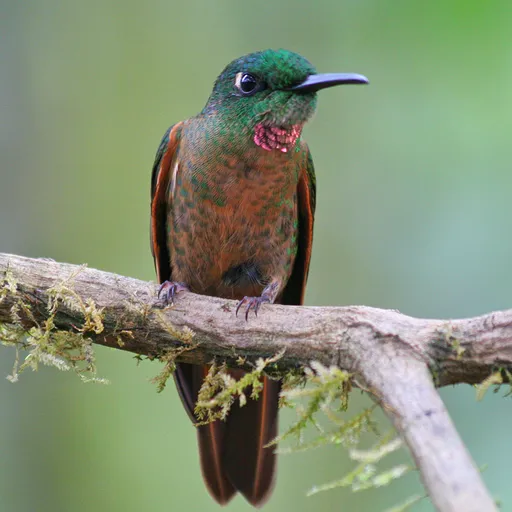
Fawn-breasted Brilliant
Heliodoxa rubinoides
Least Concern
Listen
XC250932 · Niels Krabbe · Zamora-Chinchipe: Cerro Plateado camp 2, Ecuador · CC BY-SA 4.0
Overview
The fawn-breasted brilliant (Heliodoxa rubinoides) is a medium-sized hummingbird native to South America. It is also known by the common names lilac-throated brilliant and brillante pechigamuza, and is currently classified as Least Concern on the IUCN Red List.
Identification
- A medium-sized hummingbird measuring 11 to 13 cm in length, with a stout, slightly decurved black bill.
- Males possess shining bronzy-green upperparts, warm buffy-cinnamon underparts with green spotting, and a distinctive small, isolated pinkish or lilac gorget patch.
- Females resemble males but feature duller plumage, more extensive green spotting, and a smaller or absent throat patch; juveniles have buffy fringes on head feathers.
- Vocalisations include sharp metallic 'tchik' notes and a common 'swi-swi-swi-swu' call, accompanied by audible wing buzzing during flight.
Habitat
Found in the Andes from western Colombia to central Bolivia, this species inhabits humid montane forests and cloud forests, primarily in the lower to mid-levels of the forest interior. It typically occupies elevations between 1,000 and 2,600 m, though most records come from between 1,100 and 2,200 m.
Diet
The diet consists primarily of nectar from brightly coloured tubular flowers, supplemented by small insects and spiders for protein. Foraging involves hawking in flight, gleaning from foliage, and plucking from spider webs, while nectar is accessed by hovering or perching and inserting the tongue up to 13 times per second.
Did you know?
Despite the species name rubinoides suggesting a ruby-red appearance, it refers to the male's pink throat patch which resembles a ruby. The genus name Heliodoxa derives from Greek words meaning 'sun' and 'glory'.
Sources
- Wikipedia · CC BY-SA 4.0
- Wikidata · CC0 1.0