
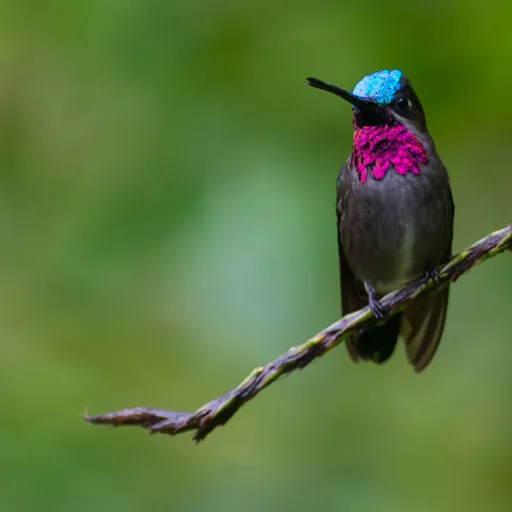
Long-billed Starthroat
Heliomaster longirostris
Least Concern
Overview
The long-billed starthroat (Heliomaster longirostris) is a species of hummingbird in the "mountain gems" tribe of the subfamily Trochilinae. It is distributed across Mexico, Central America, Trinidad, and most of South America.
Identification
- A small hummingbird measuring 11 to 12 cm in length, with a long, almost straight, black bill and a small white spot behind the eye.
- Males of the nominate subspecies feature a glittering blue to greenish blue crown, a black face with a white malar stripe, and a dark metallic purple gorget.
- The calls include a rich liquid 'tseep' or 'tsew' and 'sqeaky twitters', the latter emitted during chases.
Habitat
Found from southern Mexico through Central America into South America, as well as on Trinidad, the species inhabits humid semi-open landscapes such as woodland edges, pastures with trees, and secondary forest. It avoids the interior of closed forest and occupies lowlands and foothills from sea level to about 1,500 m.
Diet
This bird feeds primarily on nectar from large trees, vines, shrubs, and Heliconia, foraging by trap-lining circuits of flowering plants or defending flower-laden trees. It also consumes small insects, often capturing them on the wing high in the air or by gleaning from vegetation.
Did you know?
The species appears to be able to tolerate much disturbance and may even be favoured by deforestation, provided that scattered trees and groves remain. Its movements are erratic and poorly understood, seemingly triggered by the flowering of different plant communities.
Sources
- Wikipedia · CC BY-SA 4.0
- Wikidata · CC0 1.0