
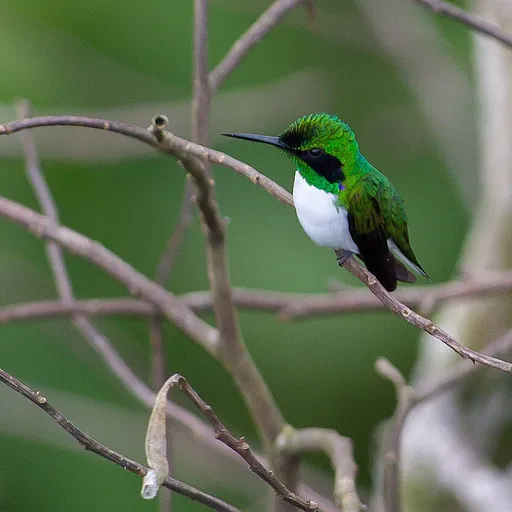
Black-eared Fairy
Heliothryx auritus
Least Concern
Listen
XC250933 · Niels Krabbe · Zamora-Chinchipe: 1-2 km W Shaimi, Nangaritza Valley, Ecuador · CC BY-SA 4.0
Overview
The black-eared fairy (Heliothryx auritus) is a species of hummingbird in the subfamily Polytminae, commonly known as the mangoes. It is found in every mainland South American country except Argentina, Chile, Paraguay, and Uruguay.
Identification
- Measures 10.1 to 13.7 cm in length and weighs 4 to 6.3 g.
- Males feature bright shiny green upperparts, pure white underparts, a long pointed tail with darkish blue central and white outer feathers, a black patch below the eye, and glittering purple ear coverts.
- Females lack the purple facial markings of males, have grayish dots on the throat and breast, and possess three outer pairs of tail feathers with a black band at their base.
- Calls consist of a short high-pitched 'tsit' and a richer 'tchip', repeated at intervals.
Habitat
The species inhabits the interior and edges of wet primary and secondary forest, typically found below 400 m but occurring as high as 800 m. It is believed to be sedentary, though some irregular movements have been reported in southern Brazil.
Diet
The black-eared fairy forages mostly in the mid-story and canopy, taking nectar from flowering plants by inserting its bill into the corolla or piercing the base of the flower to 'rob' nectar. It also feeds on small insects on the wing.
Did you know?
Unlike its close relative the purple-crowned fairy, the black-eared fairy actively feeds on small insects on the wing.
Sources
- Wikipedia · CC BY-SA 4.0
- Wikidata · CC0 1.0