
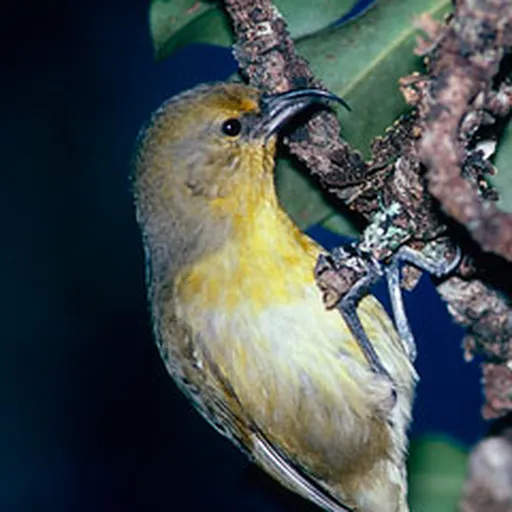
Akiapolaau
Hemignathus wilsoni
Endangered
Overview
The ʻakiapōlāʻau, also known as the Hawaiian woodpecker, is a species of Hawaiian honeycreeper endemic to the island of Hawaii. Classified as endangered, it is the only bird species on the island to occupy the woodpecker niche and may be the last remaining member of its genus.
Identification
- Length of 5.5 inches (14 cm) with a pudgy body shape.
- Plumage features an orangish head, black face mask, yellow chest, whitish bottom and tail, and gray-black wings.
- Unusually curved bill and black legs.
- Male song consists of either a loud, short 'pit-er-ieu' or a rapid 'warba-warba', accompanied by various calls including an upslurred whistle and a short 'cheedle-ee' warble.
Habitat
This bird inhabits dry and montane moist forests, primarily in old-growth mesic and wet forests in Kaʻū, Hilo District, and Hamakua. Disease-carrying mosquitoes have restricted its range to elevations between 1,300 and 2,100 metres, though it formerly occupied higher elevations on Mauna Kea where its population was extirpated in 2002.
Diet
It feeds on insects hidden within tree branches and the nectar of flowers shaped like its bill, as well as invertebrates on the forest floor. It uses its long bill to peck open bark to access larvae, then employs its thin upper bill to probe out the meal and its lower bill to crush it.
Did you know?
The ʻakiapōlāʻau may be the last of its genus following the recent disappearance of the Kauaʻi and Maui nukupuʻu. It is the only member of the subgenus Heterorhynchus, which exclusively preys on insects, contrasting with the nukupuʻu that were also nectarivores.
Sources
- Wikipedia · CC BY-SA 4.0
- Wikidata · CC0 1.0