
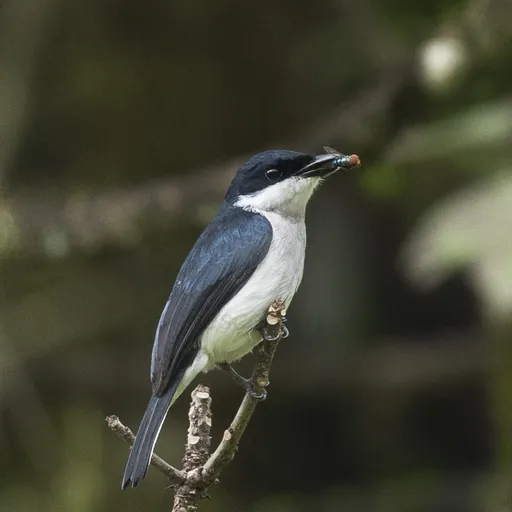
Black-winged Flycatcher-shrike
Hemipus hirundinaceus
Least Concern
Overview
The black-winged flycatcher-shrike is a species of bird in the genus Hemipus, usually placed in the family Vangidae. It is found in the Malay Peninsula and the Greater Sunda Islands, where it inhabits lowland forests and sometimes swamps and mangroves. Although its population is declining due to habitat loss, the International Union for Conservation of Nature assesses it as being of least concern.
Identification
- Approximately 15 cm in length, with males displaying a black head and upperparts with a green sheen, whereas females have sooty brown upperparts.
- Features white chin and upper throat, gull grey lower throat and breast, and a white belly.
- Black tail with a rump marked by black and white bars, and a black beak and feet.
- Calls include a 'wirrawik' and a sharp 'chisi-wik', accompanied by a high-pitched song of 'twee wi-wi-wi-wi'.
Habitat
The species ranges from the Malay Peninsula to Sumatra, Borneo, Java and Bali. It lives in the canopy of lowland forests, forest edges, and along forest roads and streams, typically found below 800 m in elevation and more commonly below 300 m. It also sometimes occurs in swamps, mangroves, and secondary forest.
Diet
This flycatcher-shrike catches insects from the underside of leaves and in the air, often perching at an exposed location. It is most often found in pairs, but also occurs singly, in small parties, and in mixed-species foraging flocks.
Did you know?
The cone-shaped nest is attached to a branch using cobweb, with the male collecting pieces of bark, lichen, fibres, and cobweb while the female shapes it by pressing her body against it. The bark camouflages the nest, making it hard to spot.
Sources
- Wikipedia · CC BY-SA 4.0
- Wikidata · CC0 1.0