
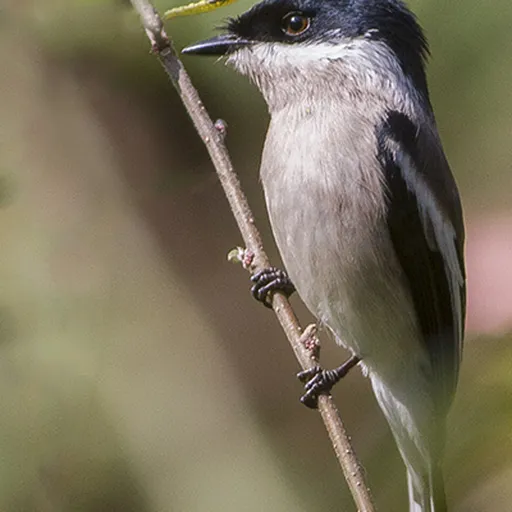
Bar-winged Flycatcher-shrike
Hemipus picatus
Least Concern
Overview
The bar-winged flycatcher-shrike (Hemipus picatus) is a small passerine bird usually placed in the family Vangidae. It inhabits the forests of tropical southern Asia, ranging from the Himalayas and the hills of southern India to Indonesia. The species is classified as Least Concern on the IUCN Red List.
Identification
- Black-capped body with contrasting white plumage, featuring a distinct white slash across the wing and a white rump. Males are velvety black while females are often greyish brown, though some populations exhibit a brownish back. Sits upright on branches with a beak that has a curved upper tip and a nostril hidden by hairs. Emits a rapid, high tsit-it-it-it or whriri-whirriri-whirriri call, sometimes accompanied by a sharp chip.
Habitat
Found in the forests of tropical southern Asia, extending from the Himalayas and the hills of southern India to Indonesia. Specific subspecies occupy the Western Ghats of India, the Himalayan foothills, the hill forests of Sri Lanka, and parts of Southeast Asia including Sumatra, Borneo, and the Malay Peninsula. It moves through the forest and rarely remains in a particular location, showing variable sensitivity to forest degradation.
Diet
Mainly insectivorous, this bird forages in the mid-canopy by gleaning foliage and making aerial sallies for flushed insects. It frequently joins mixed-species foraging flocks containing other small birds such as babblers, velvet-fronted nuthatches, and white-eyes.
Did you know?
The nest is a cup covered in lichens placed on a dry branch to mimic a natural knot in the wood, while the chicks remain still with closed eyes and bills raised to resemble a broken branch. In Sri Lanka, male and female pairs of the leggei subspecies have been reported to duet with precision.
Sources
- Wikipedia · CC BY-SA 4.0
- Wikidata · CC0 1.0