
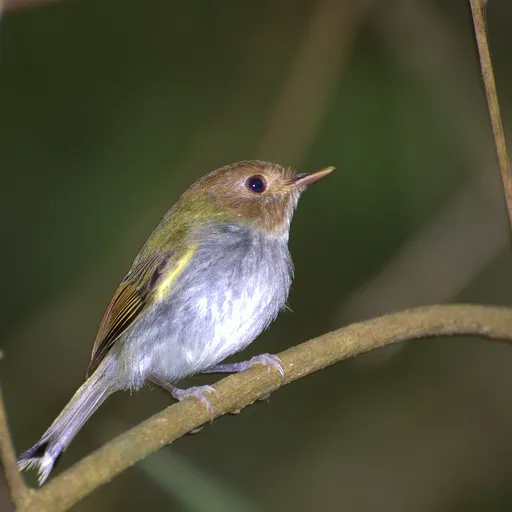
Fork-tailed Tody-Tyrant
Hemitriccus furcatus
Least Concern
Overview
The fork-tailed tody-tyrant, also known as the fork-tailed pygmy tyrant, is a species of bird in the family Tyrannidae endemic to Brazil. It is a year-round resident that inhabits the Atlantic Forest.
Identification
- Approximately 11 cm long with a distinctive forked tail; males have deeper forks than females.
- Bright cinnamon-brown forehead, brownish olive crown and nape, and a cocoa-brown to cinnamon face with a pale cinnamon eye-ring.
- Bright olive back and rump, with wings featuring bright cinnamon edges on inner flight feathers and creamy outer webs on the innermost secondaries.
- Cocoa-brown throat with a pure white band below, pale grayish breast and flanks, and a whitish belly.
- Orange-brown iris, gray maxilla, pinkish to yellowish mandible, and gray to pinkish legs.
- Song is described as a short, dry, hurried, temperamental-sounding rattle, resembling 't-drrrit' with the 't' lower.
Habitat
Endemic to east-central and southeastern Brazil, specifically found in eastern Bahia and the extreme southern regions of Minas Gerais, Rio de Janeiro, and eastern São Paulo states. It inhabits the edges of humid primary and secondary forests within the Atlantic Forest biome, favouring thickets of bamboo and vine tangles. Its elevation range spans from sea level to 1,200 m.
Diet
This species feeds on insects, though specific details regarding its diet are lacking. It typically forages singly or in pairs, and rarely joins mixed-species feeding flocks. Foraging occurs mostly in the undergrowth, where it takes prey using short upward sallies from a perch to grab insects from the underside of leaves.
Did you know?
Despite being assessed as Endangered in 2000 and Vulnerable in 2004, the species was downlisted to Least Concern in 2025, although its population is still believed to be decreasing and its range is small and highly fragmented.
Sources
- Wikipedia · CC BY-SA 4.0
- Wikidata · CC0 1.0