
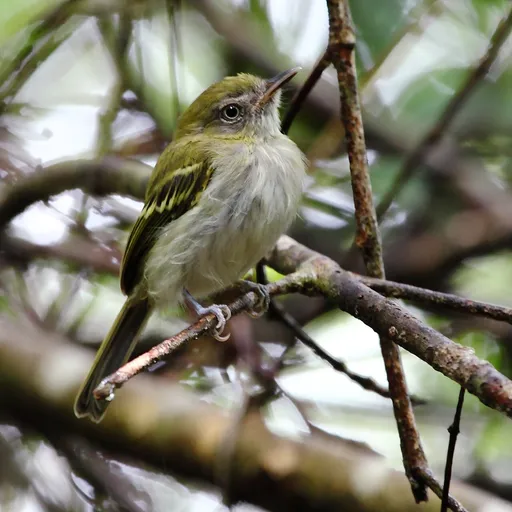
White-bellied Tody-Tyrant
Hemitriccus griseipectus
Least Concern
Overview
The white-bellied tody-tyrant, Hemitriccus griseipectus, is a small bird in the tyrant flycatcher family Tyrannidae. It is classified as Least Concern on the IUCN Red List despite a believed decreasing population, largely due to its very large range across South America.
Identification
- Length of 9.5 to 11 cm with a weight of 8 to 10 g.
- Olive-green crown, nape, back, rump, and tail, with dusky wings featuring two distinct pale yellow wing bars.
- Very light gray breast with white streaking and a yellow tinge on the sides, contrasting with a whitish throat and belly.
- Pale straw or whitish iris, black bill with a sometimes pinkish mandible base, and light grayish legs.
- Song consists of a simple chiming pair or trio of notes, described as ta-TEEK or ta-TI'PIP.
Habitat
Found in Bolivia, Brazil, and Peru, the species inhabits various humid forest types, including terra firme, transition forest, cloud forest, and campinarana for the nominate subspecies, while the naumburgae subspecies prefers gallery and dense humid forest in northeastern Brazil. It generally occupies the lower and mid-levels of the forest, occasionally reaching the subcanopy. The distribution is disjunct, with the nominate subspecies ranging widely in the central Amazon Basin and naumburgae restricted to a small area between Rio Grande do Norte and Alagoas.
Diet
The bird feeds on arthropods and fruits, typically foraging singly or in pairs, and occasionally joining mixed-species feeding flocks. It captures most of its food by making short upward sallies from a perch to grab prey from the undersides of leaves, a method also used by the naumburgae subspecies, which additionally takes about half of its prey in mid-air.
Did you know?
Breeding seasons differ markedly between the two subspecies, with the nominate appearing to breed between August and October and H. g. naumburgae between January and April. Only a single nest of the naumburgae subspecies is known, constructed as a hanging bag with a side entrance from grass, palm leaves, and fungal filaments, while no nests have been recorded for the nominate subspecies.
Sources
- Wikipedia · CC BY-SA 4.0
- Wikidata · CC0 1.0