
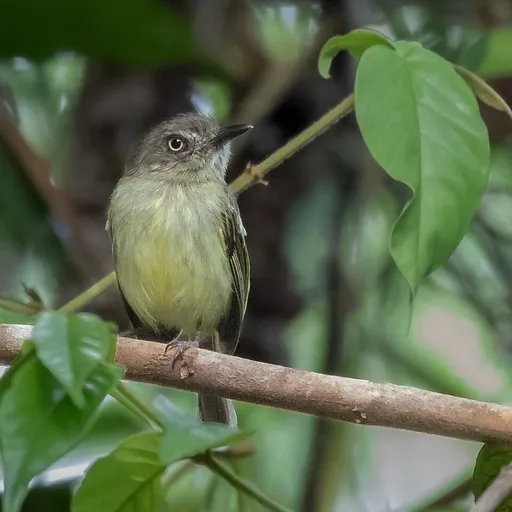
Johannes's Tody-Tyrant
Hemitriccus iohannis
Least Concern
Overview
Johannes's tody-tyrant, also known as Joao's tody-tyrant, is a species of tyrant flycatcher classified as Least Concern by the IUCN. It is a monotypic species that was originally described in 1907 and has a complex taxonomic history involving several genus reassignments before being placed in Hemitriccus.
Identification
- Approximately 11 cm in length with a bright olive crown, back, rump, and tail.
- Throat is whitish with very thin black streaks, while the breast is pale yellow with blurry olive streaks and the belly is unstreaked yellow.
- Wings are dusky olive with two indistinct yellow wing bars formed by edges and tips on the flight feathers and coverts.
- Song consists of accelerating, rising trilled 'tew-tur'r'r'r'e'e'e'e?' phrases interspersed with single 'tew' notes or slow, rising series of 3-6 'tew' notes.
Habitat
Found in a disjunct range across eastern Peru, northern Bolivia, western Brazil, southern Colombia, and eastern Ecuador. It primarily inhabits humid subtropical forest along watercourses and oxbow lakes, favouring vine tangles and dense shrubby areas, and is found in terra firme forest in Colombia. Elevations range from approximately 200 m in Ecuador to 800 m in Peru.
Diet
This species feeds on arthropods, typically foraging singly, in pairs, or in small family groups within the mid- to upper levels of dense brush and vine tangles. It captures prey using short upward sallies from a perch to grab it from the underside of leaves, and very seldom joins mixed-species feeding flocks.
Did you know?
Johannes's tody-tyrant is considered 'uncommon, inconspicuous, and easily overlooked' in Peru, often detectable only by its voice. Its taxonomic history is complicated, having been treated as a subspecies of the stripe-necked tody-tyrant and assigned to different genera throughout the twentieth century before being consolidated into Hemitriccus.
Sources
- Wikipedia · CC BY-SA 4.0
- Wikidata · CC0 1.0