
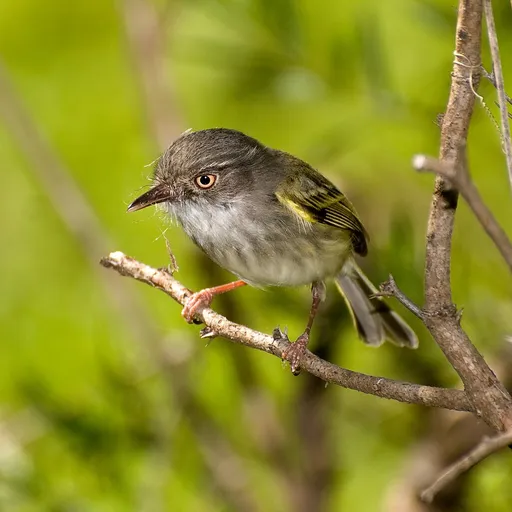
Pearly-vented Tody-Tyrant
Hemitriccus margaritaceiventer
Least Concern
Overview
The pearly-vented tody-tyrant (Hemitriccus margaritaceiventer) is a species of tyrant flycatcher found throughout mainland South America, with the exception of Chile, Ecuador, French Guiana, and Suriname. Classified as Least Concern by the IUCN, it is considered generally fairly common across its extensive range.
Identification
- Approximately 10 to 11 cm long with a grey crown, greyish-brown face featuring whitish lores and eye-ring, and drab greyish-brown to brownish-olive upperparts.
- White underparts with faint greyish streaking, wings showing two pale wing bars, and a pale iris with a reddish-brown to blackish upper mandible.
- Song consists of a soft yet emphasized series described as 'tuc-tic-tuc-tuc-tuc-tuc' or similar trills, accompanied by sharp calls such as 'tuk, tuk, quéek, quéek'.
Habitat
This species inhabits a variety of landscapes, predominantly shrubby and dry areas such as arid scrub, shrubby pastures, and the undergrowth of deciduous woodlands. In some regions it favours forest edges, while in others it occupies dense heathlands or gallery forest. Its elevation range varies by location but typically extends from sea level up to 1,000 m, with some populations occurring higher in Peru and Venezuela.
Diet
The pearly-vented tody-tyrant feeds on insects, typically foraging alone or in pairs rather than joining mixed-species flocks. It mostly forages from just above the ground to eye level, capturing prey through short upward sallies from perches, gleaning from branches, or seizing insects in mid-air with short flights.
Did you know?
The species has a complicated taxonomic history, having originally been described as Todirostrum margaritaceiventer in 1837 and subsequently placed in the genera Euscarthmornis and Idioptilon before being merged into Hemitriccus.
Sources
- Wikipedia · CC BY-SA 4.0
- Wikidata · CC0 1.0