
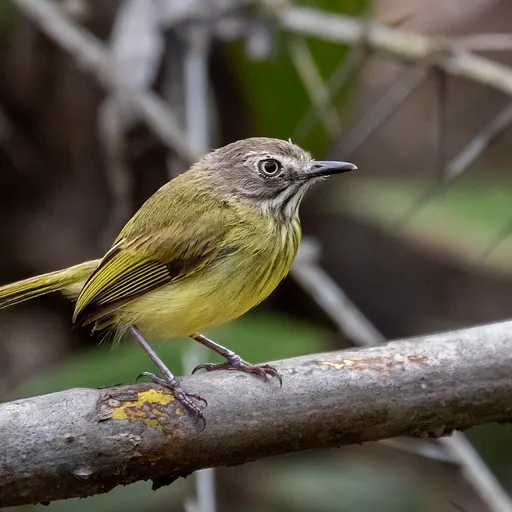
Stripe-necked Tody-Tyrant
Hemitriccus striaticollis
Least Concern
Overview
The stripe-necked tody-tyrant (Hemitriccus striaticollis) is a small songbird belonging to the family Tyrannidae, commonly known as the tyrant flycatchers. Assessed as Least Concern by the IUCN, it is found across parts of South America, including Brazil, Bolivia, Colombia and Peru.
Identification
- Adults measure 11 to 12 cm in length and weigh between 7.8 and 11 g, with a blackish bill that has a paler base to the mandible and light grey legs.
- The plumage features a greyish brown crown, olive back and rump, and a white throat with distinct brownish streaks continuing onto a bright yellow breast with a greenish tinge.
- It possesses a large white spot above the lores, a white eye-ring, and a whitish to pale yellow iris.
- In Brazil, the song is described as a very high, fast, liquid yet sharp 'Didrdr', 'Wic', or sweeping 'Wheet', while in Peru it produces a loud, ringing 'PEE-ti-ti-ti' phrase.
Habitat
This species occupies somewhat open landscapes such as semi-humid to humid secondary woodland, thickets and bamboo along watercourses, as well as the undergrowth of wooded savanna in Colombia and parts of Peru. Its elevation range varies by region, spanning from sea level to 1,000 m in San Martín, Peru, though it is typically found below 700 m in Brazil. The bird has a disjunct distribution with a main population in central and southern Amazonian Brazil, extending into northern Bolivia, southeastern Peru, and small separate populations in Colombia, Peru and eastern Brazil.
Diet
The stripe-necked tody-tyrant feeds on arthropods, typically foraging singly or in pairs and rarely joining mixed-species flocks. It operates in the mid- to upper levels of low-stature forest and shrubby edges, often using short upward sallies from a perch to grab prey from the underside of leaves.
Did you know?
Despite being a year-round resident, almost nothing is known about its breeding biology beyond a single nest discovered in November in Brazil. This nest was a bag constructed primarily from grass, plant fibres and moss, hanging approximately 1 m above the ground from a small tree branch.
Sources
- Wikipedia · CC BY-SA 4.0
- Wikidata · CC0 1.0