
Munchique Wood Wren
Henicorhina negreti
Vulnerable
Overview
The Munchique wood wren (Henicorhina negreti) is a Vulnerable species in the wren family, Troglodytidae, that was only described as new to science in 2003. It is a monotypic species found exclusively in the Western Andes of Colombia, closely related to and probably derived from the grey-breasted wood wren.
Identification
- Adults measure 10.8 to 11.7 cm in length and weigh between 15.2 and 16.7 g.
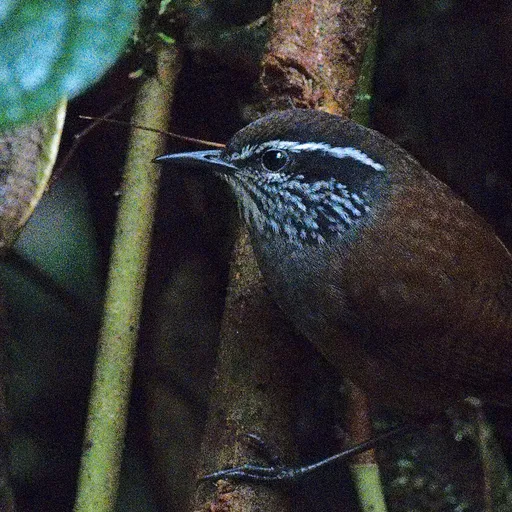
- Plumage features a dark brown crown with blackish marks, a thin white supercilium, and a dull black line running from the lores through the eye.
- The throat is white with black streaking at the lower edge, the breast is medium gray, and the abdomen and flanks display dark gray to black bars.
- Song consists of phrases containing 6 to 12 pure notes, often with more than ten repeated phrases, while calls are mostly churrs.
Habitat
This species inhabits the Pacific slope of Colombia's Western Andes, specifically within very wet and stunted cloud forest that is almost continuously in fog and rich in epiphytes. Its distribution is restricted to a few isolated areas, including the Munchique Massif in Cauca Department and regions where Chocó, Antioquia, and Risaralda meet. It occupies elevations ranging from 2,250 to 2,640 m.
Diet
The Munchique wood wren forages low in the vegetation, typically below 2 m above the ground but occasionally reaching up to 4 m. It occasionally associates briefly with mixed-species foraging flocks that enter its territory but does not follow them. Diet analysis of stomach contents reveals beetles, flies, and other arthropods.
Did you know?
Despite having an overall range spanning 18,700 km², the actual area of suitable habitat for this species might be as small as 8 km². It was first observed by Steven Hilty in the 1980s but remained undescribed until 2000, when detailed studies distinguished it from the more widespread grey-breasted wood wren.
Sources
- Wikipedia · CC BY-SA 4.0
- Wikidata · CC0 1.0