
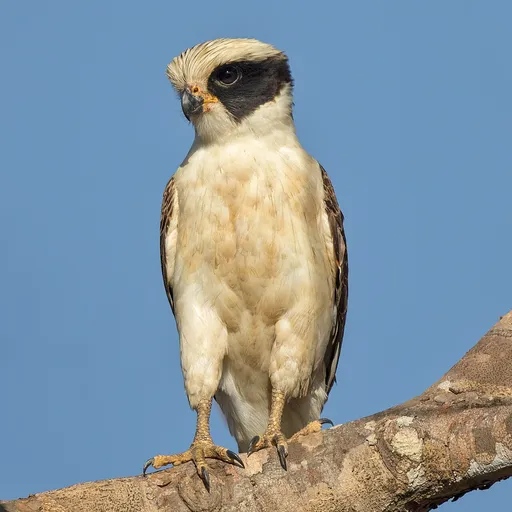
Laughing Falcon
Herpetotheres cachinnans
Least Concern
Listen
XC590778 · Nelson Hernández · Piedecuesta, Santander, Colombia · CC BY 4.0
Overview
The laughing falcon (Herpetotheres cachinnans) is a medium-sized bird of prey in the family Falconidae, distinguished as the only species in the genus Herpetotheres. It is characterised by its loud, distinctive vocalisations and its strong specialisation in hunting reptiles, particularly snakes.
Identification
- Measures 45 to 56 cm in length with a wingspan of 79 to 94 cm, featuring short, rounded wings and a long tail that give it a shape more akin to an Accipiter hawk than typical falcons.
- Plumage includes creamy white underparts, a dusky black face mask extending into a narrow neck collar, and a small bushy crest on the crown.
- The tail is dusky black with four or five white bands, while the underwings show a rufous patch at the base.
- Highly vocal, emitting long rhythmic series of loud hollow notes often beginning with a bubbly laugh and progressing into 'wah' or 'w-hah' phrases.
Habitat
Found from Mexico south through Central America to South America, excluding Chile and Uruguay, the species inhabits a wide variety of semi-open treed landscapes such as primary and secondary forests, gallery forests, palm groves, and savannas. It shuns the interior of dense forests and is generally a bird of the lowlands, typically occurring below 1,500 m, though it reaches higher elevations locally in Central America and South America.
Diet
The bird mainly feeds on snakes, including venomous species such as coral snakes, and also consumes lizards, small rodents, bats, and fish. It usually hunts from a perch, dropping or pouncing on prey with an audible thud, and carries small snakes in its bill while large ones are held in one foot.
Did you know?
The generic name Herpetotheres is derived from Latinised Ancient Greek meaning 'reptile mower', reflecting the bird's specialised diet. In Chiapas, Mexico, the Ch'ol Maya believe the bird can kill venomous snakes because they are healers capable of curing themselves if bitten.
Sources
- Wikipedia · CC BY-SA 4.0
- Wikidata · CC0 1.0