
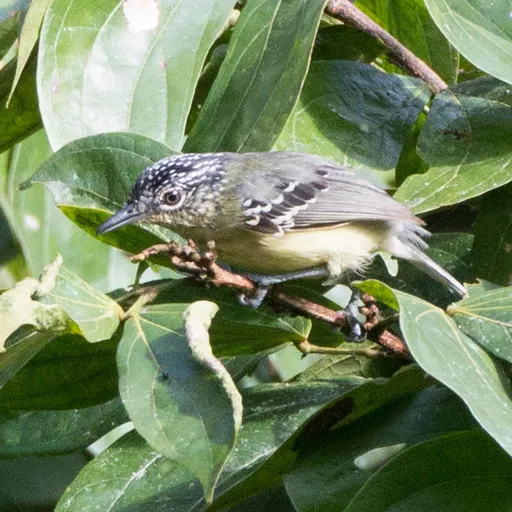
Yellow-breasted Antwren
Herpsilochmus axillaris
Least Concern
Listen
XC249331 · Niels Krabbe · Napo: 3 km NW Guagua Sumaco, Ecuador · CC BY-SA 4.0
Overview
The yellow-breasted antwren (Herpsilochmus axillaris) is a small bird belonging to the subfamily Thamnophilinae within the family Thamnophilidae. It is native to the Andean regions of Colombia, Ecuador, and Peru, where it is classified as Least Concern on the IUCN Red List.
Identification
- Size: 11 to 12 cm in length, weighing 10 to 13 g.
- Plumage: Males of the nominate subspecies feature a black crown with white spots and a broken whitish supercilium on a mottled blackish and yellow-olive face; upperparts are olive-gray with black wing coverts edged in yellow-tinged white, and a dark gray tail with white tips. Females differ by having a cinnamon-rufous crown, olive-buff upperparts, and darker olive underparts with a yellow belly center.
- Song: Described as a rattle-like trill of dry notes, transcribed as 'tree-ee-ee-ee-ee-ee-ew' in Ecuador and 'tee-tee-TI-TI-titi'ti'titititititer' in northern Peru; calls include a short, downslurred whistle written as 'tew' or 'tchew'.
Habitat
This species inhabits the interior and edges of humid evergreen forest, favouring the canopy layer. Its elevation range varies by country, spanning 800 to 2,000 m in Colombia, 800 to 1,700 m in Ecuador, and 750 to 1,900 m in Peru.
Diet
The diet consists primarily of insects and probably spiders. The bird forages actively and methodically in pairs, family groups, or mixed-species flocks, typically gleaning prey from leaves, stems, and vines in the mid-level and canopy, with a preference for vine tangles in the mid-levels, occasionally using short sallies to hover-glean.
Did you know?
Despite the detailed knowledge of its physical traits and habits, the breeding biology of the yellow-breasted antwren is almost entirely unknown, with the sole documented record being a single female in Peru found ready to lay an egg in March.
Sources
- Wikipedia · CC BY-SA 4.0
- Wikidata · CC0 1.0