
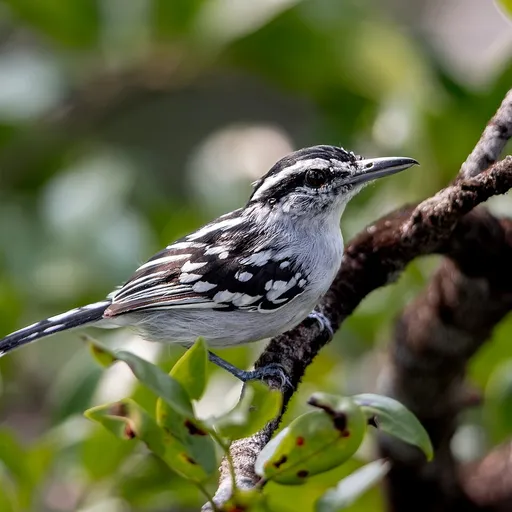
Spot-backed Antwren
Herpsilochmus dorsimaculatus
Least Concern
Overview
The spot-backed antwren (Herpsilochmus dorsimaculatus) is a species of bird in the family Thamnophilidae, classified as Least Concern on the IUCN Red List. It is a monotypic species found in the humid forests of South America, though its population is believed to be decreasing.
Identification
- Males possess a black crown and nape, a long white supercilium, and a black streak through the eye, with dark gray backs featuring white-edged feathers and blackish patches.
- Females differ by having a buff forehead, white spots on the crown, and a buff breast, otherwise resembling males.
- The song is described as a very high, fast, slightly rising then descending trilling series lasting about two seconds, while calls are short, downslurred plaintive notes repeated irregularly.
- Adults measure 11 to 12 cm in length and weigh between 9.5 and 10.5 g.
Habitat
This species inhabits the subcanopy and canopy of humid evergreen forests in eastern Colombia, southern Venezuela, and northwestern Brazil up to the Rio Trombetas. It favours igapó in Venezuela, terra firme forest in Colombia and much of Brazil, and campina woodlands on white-sand soils in parts of Brazil. Elevation limits range from 600 m in most areas to 500 m in Colombia.
Diet
The diet consists of insects and probably spiders, though it has not been detailed extensively. The bird forages singly, in pairs, or in family groups, often joining mixed-species feeding flocks, but is not known to follow army ants. It typically feeds between 15 and 30 m above the ground, gleaning leaves, stems, and vines by reaching or lunging from perches, occasionally using short hovering sallies.
Did you know?
Adult males have a hidden white patch between their white-edged black scapulars. Despite having a large range with extensive intact habitat, the species is considered highly sensitive to human disturbance.
Sources
- Wikipedia · CC BY-SA 4.0
- Wikidata · CC0 1.0