
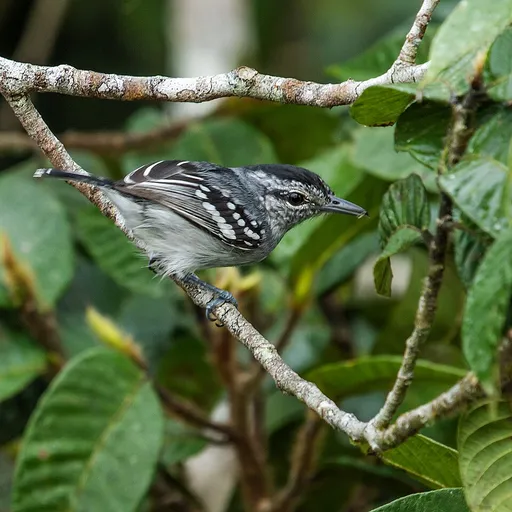
Dugand's Antwren
Herpsilochmus dugandi
Least Concern
Listen
XC248711 · Niels Krabbe · Sucumbíos: 'Sacha Lodge', n bank Río Napo, Ecuador · CC BY-SA 4.0
Overview
Dugand's antwren (Herpsilochmus dugandi) is a species of bird in the family Thamnophilidae, commonly known as the typical antbirds. It is a monotypic species that was previously considered conspecific with the spot-tailed antwren but is now treated as part of a superspecies. The bird is assessed as Least Concern by the IUCN, though its population is believed to be decreasing.
Identification
- Adult males feature a black crown and nape, a long pale gray to white supercilium, and a black streak through the eye, while females have a rufous crown and buffy underparts.
- Males possess a dark gray back and rump with black patches, white-edged black scapulars, and a large white patch between the scapulars; wings are black with white tips on the coverts and flight feathers.
- The tail is black with white tips and a long white streak on the central feathers.
- The song consists of a fairly rapid, accelerating series of rich notes described as "tchew-chew-tew-tew 'tu 'tu 'tu 'tututututu", accompanied by a quiet "tchew" call.
Habitat
Found in far western Amazonia, this species ranges from extreme southern and southeastern Colombia through eastern Ecuador into northeastern Peru north of the rios Marañón and Amazon. It inhabits the sub-canopy to canopy of humid evergreen forest, primarily terra firme and floodplain forest, with a preference for vine tangles. Elevations typically range between 100 m and 450 m, occasionally reaching up to 600 m.
Diet
The diet primarily consists of insects and probably spiders, though it has not been detailed. The bird forages singly, in pairs, in family groups, or as part of mixed-species flocks, typically between 20 and 40 m above the ground. It captures prey by gleaning leaves, stems, and vines from perches, using short sallies or hover-gleaning, but does not follow army ants.
Did you know?
Only a single nest of Dugand's antwren has ever been documented, observed in Peru in June, which was a cup of green moss and lichens well-hidden in a branch fork 35 m above the ground. Males were observed carrying food to the nest and brooding the young.
Sources
- Wikipedia · CC BY-SA 4.0
- Wikidata · CC0 1.0