
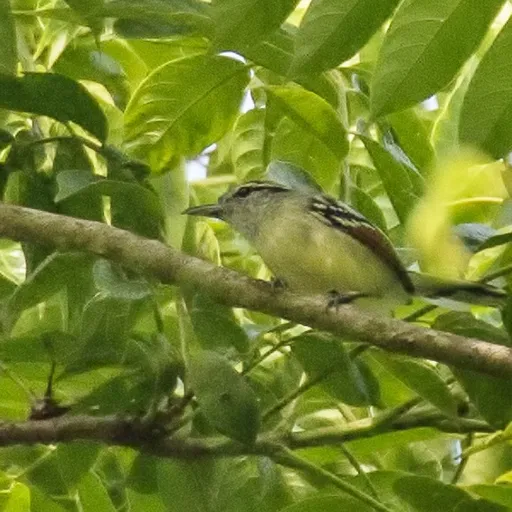
Rusty-winged Antwren
Herpsilochmus frater
Listen
XC250984 · Niels Krabbe · Napo: Napo Galeras, Ecuador · CC BY-SA 4.0
Overview
The rusty-winged antwren (Herpsilochmus frater) is a species of bird in the family Thamnophilidae, commonly known as the typical antbirds. It is found across a wide range in South and Central America, including Bolivia, Brazil, Colombia, Ecuador, Guyana, Panama, Peru, Suriname, and Venezuela.
Identification
- Size ranges from 10 to 12.5 cm in length and weighs approximately 10 to 12.5 g.
- Adult males of the nominate subspecies feature a black crown and nape, a wide white supercilium, and a black stripe through the eye.
- Males have ashy gray upperparts with black spots and a black patch between the scapulars, while flight feathers are blackish with dark cinnamon red outer webs.
- Females display a rich chestnut-rufous crown, brownish olive-gray upperparts, and stronger yellow underparts than males.
- The song is described as a stuttered series of notes beginning with accelerating melodious notes and shifting to a decelerating raspy rattle.
Habitat
The species inhabits the interior and edges of lowland and foothill evergreen forests, including terra firme and gallery forest, typically occupying the mid-storey to subcanopy and favouring dense vine tangles. Its range is disjunct, with subspecies H. f. exiguus found in western Panama, northwestern Colombia, and western Ecuador, and subspecies H. f. frater distributed across the Eastern Andes of Colombia, eastern Ecuador and Peru, northern Bolivia, and parts of Brazil, Venezuela, Guyana, and Suriname.
Diet
The diet is primarily insectivorous but also includes spiders, and the bird forages actively and methodically by gleaning from leaves, stems, and vines. It usually forages singly, in pairs, or in family groups, and often joins mixed-species feeding flocks as it passes through its territory. Feeding typically occurs between 8 and 30 m above the ground, though it can descend to 3 m in stunted forests.
Did you know?
Despite its wide distribution, almost nothing is known about the breeding biology of the rusty-winged antwren. Its song structure is notably complex, shifting from an accelerating series of melodious notes to an unmelodious raspy rattle.