
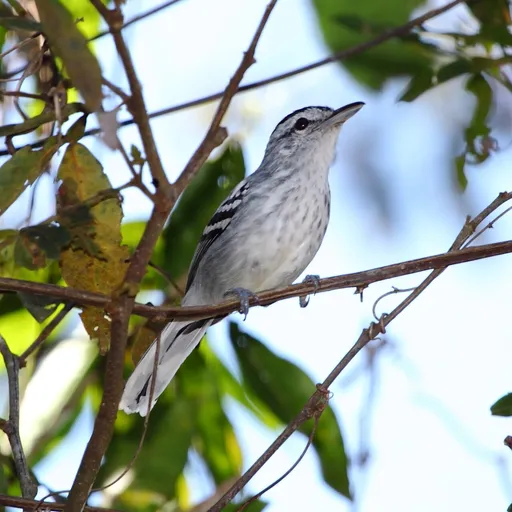
Large-billed Antwren
Herpsilochmus longirostris
Least Concern
Overview
The large-billed antwren (Herpsilochmus longirostris) is a species of bird in the subfamily Thamnophilinae of the typical antbird family, Thamnophilidae. It is found in Bolivia and Brazil, where it is considered a year-round resident. The IUCN has assessed the species as being of Least Concern, with a large range and an unknown population size that is believed to be decreasing.
Identification
- Size: 12 to 13 cm (4.7 to 5.1 in) long, weighing 12 to 14 g (0.42 to 0.49 oz).
- Plumage (Males): Black crown and nape, long whitish supercilium, narrow black eye-streak, grayish ear coverts, gray back and rump with a black and white patch between the scapulars, and white-tipped black uppertail coverts; wings black with white-tipped coverts and flight feathers with white edges; tail feathers varying from white to black with white edges or tips; throat and underparts mostly white with tiny black spots on the breast sides and grayish sides and flanks.
- Plumage (Females): Rufous-cinnamon crown, cinnamon-tinged gray ear coverts and upperparts, and cinnamon neck, throat, and underparts; wings and tail similar to the male's.
- Vocalization: Song is a high, fast, chattering series rising at the start and descending and decelerating at the end; calls include a rapidly delivered triplet with notes becoming shorter and dropping in pitch, and an abrupt downslurred note.
Habitat
Found south of most of Amazonia, in the northern parts of Bolivia's Beni and Santa Cruz departments and in south-central to northeastern Brazil, roughly bounded by the states of Mato Grosso, Tocantins, and Paraná, but found locally as far northeast as southern Ceará and Piauí. It inhabits deciduous and semi-deciduous forest, gallery forest, and palm groves, and does not favour any particular level of the forest; in Bolivia it also often inhabits small patches of forest in otherwise open cerrado. It ranges in elevation from about 150 to 1,100 m (500 to 3,600 ft).
Diet
Its diet has not been fully detailed but includes insects and probably spiders. It forages singly, in pairs, in family groups, and often as a member of a mixed-species feeding flock, typically between 1.5 and 10 m (5 and 35 ft) above the ground, and sometimes as high as 15 m (50 ft). It forages actively and methodically, usually capturing prey by gleaning from leaves, stems, and vines by reaching and sometimes lunging from a perch, and also makes short sallies to access leaves and occasionally takes prey from atop leaf litter on the ground; it is not known to follow army ants.
Did you know?
One observed nest was a small cup made of leaves, fungal filaments, and plant fibers, placed 1.5 m (5 ft) above the ground in a small tree, though little else is known about the species' breeding biology.
Sources
- Wikipedia · CC BY-SA 4.0
- Wikidata · CC0 1.0