
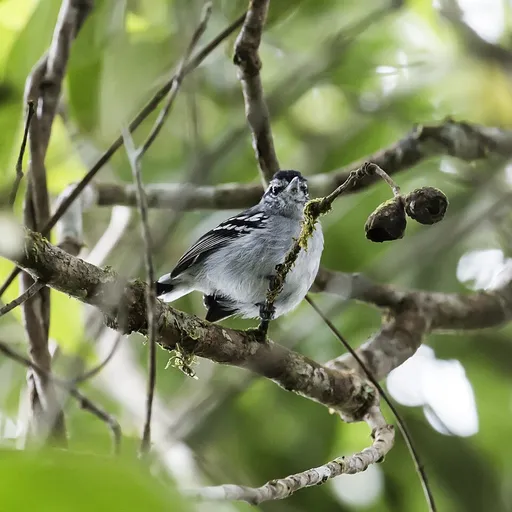
Ash-throated Antwren
Herpsilochmus parkeri
Vulnerable
Overview
The ash-throated antwren (Herpsilochmus parkeri) is a Vulnerable species of bird in the family Thamnophilidae, commonly known as the typical antbirds. It is an endemic species found exclusively in Peru. The bird was described as a new species in 1986, with its specific epithet honouring the renowned ornithologist Theodore A. Parker III.
Identification
- Males feature a black crown, pale greyish white supercilium, and black scapulars with wide white outer webs, contrasting with the orangish cinnamon forehead and dusky crown of females.
- Both sexes possess black wings with white-tipped coverts and tails, measuring between 11.5 and 13 cm in length.
- The song consists of a rapid, accelerating-decelerating series of rising and falling rich notes, often preceded by two or three introductory notes described as pew-PEW-PEW-pee'e'E'E'E'e'e-e-e-e-u.
- Adults have brown irises, a black upper mandible, a greyish blue lower mandible, and blue-grey or greyish blue legs.
Habitat
Known only from the watershed of the Río Mayo in the northern Peruvian Department of San Martín, this species inhabits a variety of wooded landscapes such as tall humid montane forest and mid-height semi-stunted forest. It occupies a narrow elevation range of 1,250 to 1,450 m, frequently on sandy soils. The ash-throated antwren is a year-round resident within this restricted area.
Diet
The diet includes insects and spiders, though specific details remain unrecorded. The bird usually forages in pairs and frequently joins mixed-species feeding flocks to locate food.
Did you know?
The species was honoured with a name dedicated to Theodore A. Parker III, who was described as "the finest field birder/ornithologist that the world had ever seen". Its breeding season is believed to span from May to September or October, although little else is known about its breeding biology.
Sources
- Wikipedia · CC BY-SA 4.0
- Wikidata · CC0 1.0