
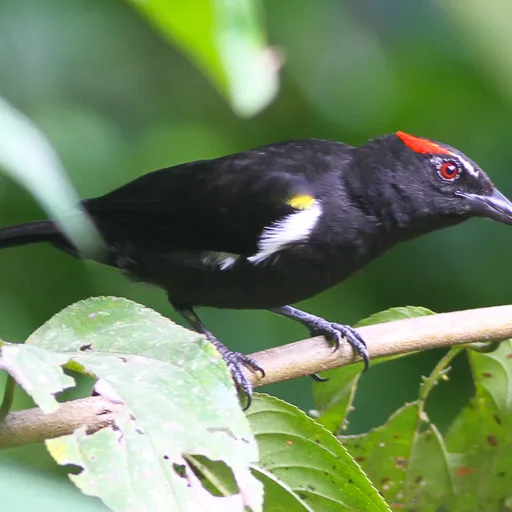
Scarlet-browed Tanager
Heterospingus xanthopygius
Least Concern
Listen
XC242772 · Niels Krabbe · Esmeraldas: 23 road km NNW Alto Tambo, 2 km N main road, Ecuador · CC BY-SA 4.0
Overview
The Heterospingus xanthopygius is a large tanager species in the family Thraupidae, native to the lowlands and foothills of Colombia, Ecuador, and Panama. It is classified as a species of Least Concern by the IUCN, with an estimated mature population of at least 50,000 individuals.
Identification
- A large tanager approximately 17 cm long, featuring a heavy bill with a slight hook at the tip.
- Sexually dimorphic; adult males of the nominate subspecies are mostly sooty black with a distinctive white-to-scarlet supercilium that forms a tuft behind the eye, while females are dark leaden gray.
- Both sexes possess a bright yellow rump, dark red irises, blackish bills, and dark gray legs and feet.
- The song is described as a squeaky, twittering, and rhythmic "cheero-bitty cheero-bitty cherro-pit-sup", accompanied by loud, forceful chips and thin, high tseet notes.
Habitat
This species inhabits the canopy and edges of humid to wet primary and secondary forests in the lowlands and foothills. Its range extends from eastern Panama's Darién Province into Colombia, covering the northern ends of the Western and Central Andes and the Magdalena River valley, as well as along the Pacific slope into northwestern Ecuador.
Diet
The scarlet-browed tanager feeds on plant material, such as Cecropia catkins and Miconia berries, and arthropods. It forages from the mid-levels to the canopy of the forest, typically in pairs or small groups, and regularly joins mixed-species feeding flocks.
Did you know?
The species' common name is derived from the male's striking supercilium, which begins thinly with white and broadens to scarlet, forming a prominent tuft behind the eye.
Sources
- Wikipedia · CC BY-SA 4.0
- Wikidata · CC0 1.0