
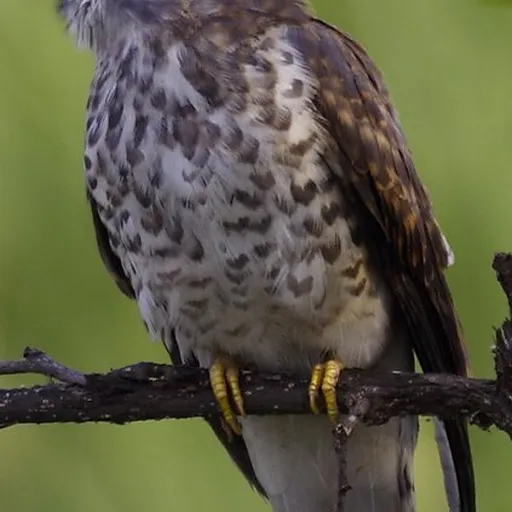
Common Hawk-Cuckoo
Hierococcyx varius
Least Concern
Overview
The Hierococcyx varius, commonly known as the brainfever bird, is a medium-sized cuckoo that acts as a brood parasite, laying eggs in the nests of babblers. It is a resident of the Indian subcontinent and is classified as Least Concern on the IUCN Red List.
Identification
- Medium to large size, approximately 34 cm, with ashy grey plumage above and whitish underparts cross-barred with brown.
- Broadly barred tail and a distinctive yellow eye ring; subadults display large brown chevron marks on the belly.
- Flight resembles that of sparrowhawks, featuring a flap and glide style with side-to-side tail shaking when landing.
- Males produce a loud, repetitive three-note call transcribed as 'brain-fever', rising in crescendo and ending abruptly.
Habitat
Found throughout the Indian subcontinent, ranging from Pakistan and the Himalayan foothills to Sri Lanka, typically in lower elevations below 1,000 m. It inhabits garden land, tree groves, and deciduous or semi-evergreen forests. The species is generally resident but may be locally migratory in high altitudes or arid regions.
Diet
Feeds mainly on insects, including hairy caterpillars that it handles by pressing them against branches to remove toxic guts before swallowing. It is an arboreal feeder that rarely descends to the ground.
Did you know?
The bird's male call has inspired various folk interpretations across the subcontinent, such as 'where's my love' in Hindi and 'the rains are coming' in Marathi.
Sources
- Wikipedia · CC BY-SA 4.0
- Wikidata · CC0 1.0