
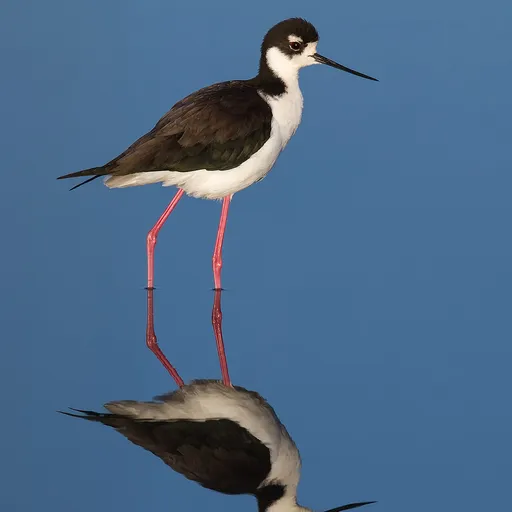
Black-necked Stilt
Himantopus mexicanus
Overview
The black-necked stilt, also known as the pied stilt, is a locally abundant shorebird of North and South American wetlands and coastlines. Classified as Himantopus mexicanus, it is found across a vast range from California to Brazil and Peru, with an isolated population in Hawaii.
Identification
- Plumage: White below with black wings and back; a continuous black area covers the hind neck and forms a cap over the head, leaving a small white spot above the eye.
- Sexual Dimorphism: Males exhibit a greenish gloss on the back and wings, particularly in breeding season, whereas females have a brown tinge in these areas.
- Structure: Characterised by long pink legs and a long, thin black bill.
- Size: Measures 35–39 cm (13.8–15.3 in) in length with a wingspan of 71–75 cm (28.1–29.7 in).
Habitat
Found in estuarine, lacustrine, salt pond, and emergent wetland habitats, generally at lowlands but reaching 2,500 m in Central America. In the US, salt evaporation ponds have become a primary wintering habitat, especially in southern San Francisco Bay. Range extends from coastal California and the Gulf of Mexico through Central America and the Caribbean to South America, with a separate population in Hawaii.
Diet
Forages by probing and gleaning in mudflats, lakeshores, and shallow waters for aquatic invertebrates, mainly crustaceans and arthropods, as well as mollusks and small fish. Inland populations primarily feed on aquatic insects and their larvae, while coastal populations consume a wider range of aquatic invertebrates. Diet occasionally includes tadpoles and, very rarely, plant seeds.
Did you know?
This bird demonstrates lateralised vision, using its left eye to identify predators, competitors, and mates, while the right eye is specialised for locating and acquiring prey.