
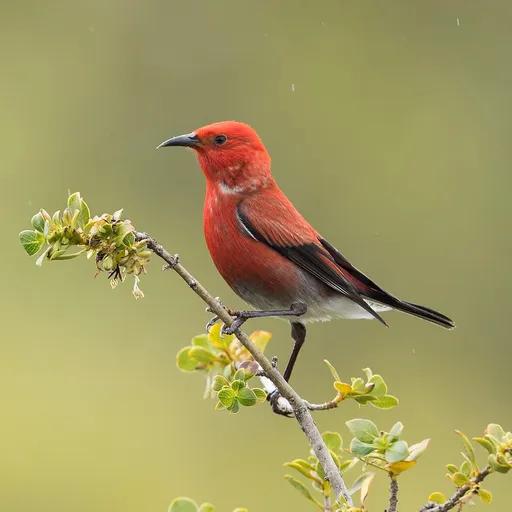
Apapane
Himatione sanguinea
Least Concern
Overview
The ʻapapane (Himatione sanguinea) is a small, crimson Hawaiian honeycreeper endemic to the Hawaiian Islands. It is the most abundant and widely distributed honeycreeper species, classified as Least Concern by the IUCN.
Identification
- Small bird measuring 13 cm in length, with males weighing around 16 g and females around 14.4 g.
- Adult plumage is bright crimson with distinct white undertail coverts and lower abdomen feathers, as well as black primaries and retricies.
- Juveniles are yellow-brown and grey, moulting into crimson adult plumage over two years.
- Often observed in a tail-up posture, displaying its white feathers.
Habitat
Found in native mesic and wet forests dominated by ʻōhiʻa and koa trees across the islands of Hawaiʻi, Maui, Lānaʻi, Kauaʻi, Molokaʻi, and Oʻahu. While detected at low elevations, most populations reside above 4,100 feet (1,200 m) to avoid mosquito-borne diseases, though the species undertakes seasonal migrations in search of flowering ʻōhiʻa.
Diet
Feeds primarily on nectar from ʻōhiʻa flowers using decurved bills and brush-tipped tongues, also gleaning insects and spiders from leaves and twigs in the canopy. They do not forage on the ground and often feed in conspecific or mixed-species flocks.
Did you know?
Hawaiians used red feathers from the ʻapapane to adorn the capes, helmets, and feather leis of nobility, alongside feathers from the ʻiʻiwi. The species has the highest reported prevalence of avian malaria but shows lower mortality rates than other honeycreeper species, potentially acting as a significant reservoir for the disease's transmission.
Sources
- Wikipedia · CC BY-SA 4.0
- Wikidata · CC0 1.0