
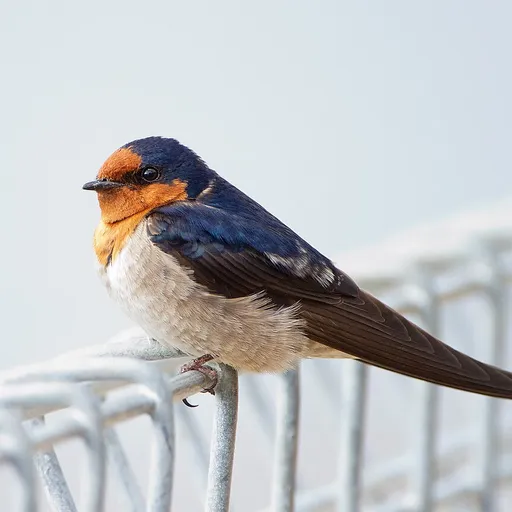
Welcome Swallow
Hirundo neoxena
Least Concern
Overview
The welcome swallow (Hirundo neoxena) is a small passerine bird in the swallow family Hirundinidae native to Australia and nearby islands. It has self-introduced into New Zealand since the early twentieth century and is classified as Least Concern on the IUCN Red List.
Identification
- Metallic blue-black upperparts with light grey breast and belly, and a distinctive rusty forehead, throat, and upper breast.
- Approximately 15 cm long, featuring a long forked tail with a row of white spots on the individual feathers.
- Call is a mixture of twittering and soft warbling notes, often accompanied by a sharp whistle in alarm.
- Young birds differ from adults by having a buffy white forehead and throat instead of rufous, and shorter tail streamers.
Habitat
This species breeds in southern and eastern Australia in open areas, man-made clearings, and urban environments, but avoids deserts and dense forests. It is found throughout most of New Zealand, where it is rare only in Fiordland, and has been recorded in New Guinea and New Caledonia. Eastern Australian populations migrate to northern regions for winter, while western and New Zealand birds are mostly sedentary.
Diet
Welcome swallows are agile fliers that feed on insects while in flight, often swooping around animals or people and cooperating to drive insects together. They frequently drink water by scooping it from lake and pond surfaces with their bills, which also allows them to catch insects near the water.
Did you know?
The common name 'welcome swallow' and the species name neoxena refer to people greeting its return as a herald of spring in southern Australia. The bird's presence is also a reliable indicator of temperature, as swallows are rarely observed when the temperature drops below -2/-3 degrees Celsius.
Sources
- Wikipedia · CC BY-SA 4.0
- Wikidata · CC0 1.0