
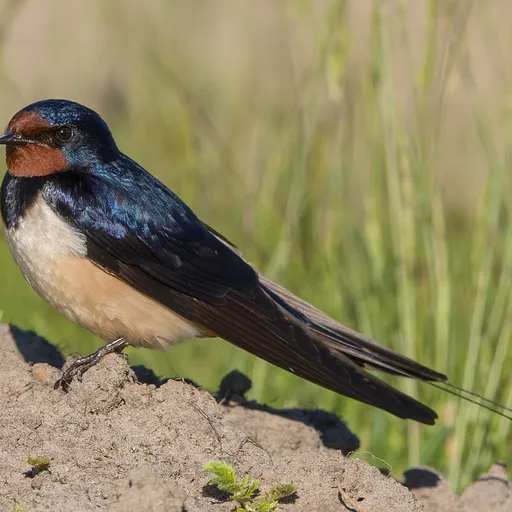
Barn Swallow
Hirundo rustica
Least Concern
Listen
XC707136 · Sonothèque ADVL · Carolles, Manche, Normandie, France · CC0 1.0
Overview
The barn swallow, Hirundo rustica, is the most widespread species of swallow in the world, occurring on all continents with vagrants reported even in Antarctica. It is a distinctive passerine bird that lives in close association with humans and has spread with human expansion.
Identification
- Steel blue upperparts with a rufous forehead, chin and throat, separated from off-white underparts by a broad dark blue breast band.
- Long, deeply forked 'swallow tail' with a line of white spots across the outer end of the upper tail.
- Adult males measure 17–19 cm in length and weigh 16–22 g, with a wingspan of 32–34.5 cm.
- Males produce a song consisting of a 'twitter warble' followed by a rising 'P-syllable', a short 'Q-syllable', and a trilled 'rattle'.
Habitat
This species prefers open country with low vegetation, such as pastures, meadows and farmland, ideally with nearby water and accessible structures like barns or stables for nesting. It breeds across the Northern Hemisphere from sea level to 2,700 m, absent only from deserts and cold northern regions, while wintering in much of the Southern Hemisphere.
Diet
The barn swallow feeds on insects caught in flight, often hovering 7–8 m above shallow water or the ground and following animals or machinery to catch disturbed prey. Large flies make up around 70% of the breeding diet, supplemented by aphids, while Hymenoptera, particularly flying ants, are important on the wintering grounds.
Did you know?
One individual barn swallow recorded a migration distance of up to 11,660 km between its breeding and wintering grounds. Additionally, communal winter roosts can be extremely large, with one in Nigeria estimated to contain 1.5 million birds.
Sources
- Wikipedia · CC BY-SA 4.0
- Wikidata · CC0 1.0