
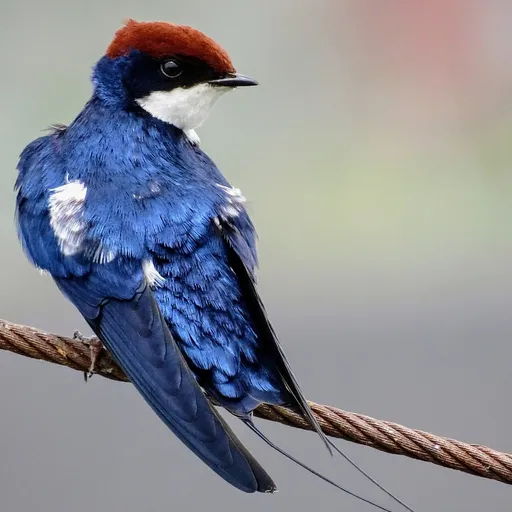
Wire-tailed Swallow
Hirundo smithii
Least Concern
Overview
The wire-tailed swallow (Hirundo smithii) is a small passerine bird belonging to the swallow family, classified as Least Concern by the IUCN Red List. It comprises two subspecies: H. s. smithii, found throughout Africa, and H. s. filifera, distributed across southern and southeastern Asia.
Identification
- Measures 18 cm in length with bright blue upperparts and bright white underparts.
- Distinguished by a chestnut cap and very long filamentous outermost tail feathers that trail behind like wires.
- Females possess shorter tail wires than males, while immature birds lack these wires and feature dull brown caps instead of chestnut.
Habitat
Found in open country near water and human habitation across Africa, southern Asia, and southeastern Asia. Populations in Pakistan and northern India migrate further south in winter, while the species is otherwise mainly resident.
Diet
Fast flyers that feed primarily on insects, especially flies, while airborne. They are typically observed foraging low over water, with which they are more closely associated than most other swallow species.
Did you know?
Unlike many swallows that nest colonially, wire-tailed swallows are solitary and territorial nesters. Their neat half-bowl nests are lined with mud collected in their beaks and placed on vertical surfaces such as cliff ledges or man-made structures.
Sources
- Wikipedia · CC BY-SA 4.0
- Wikidata · CC0 1.0