
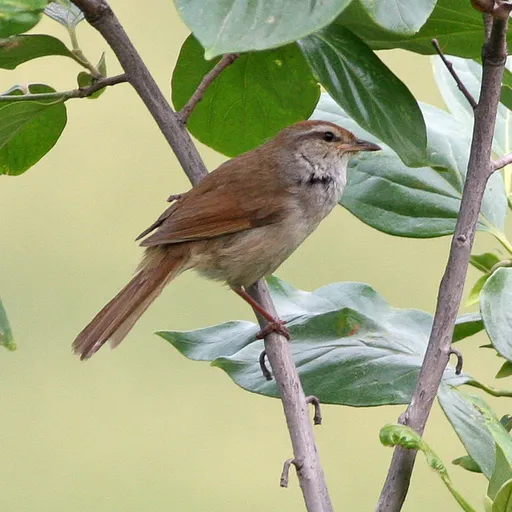
Manchurian Bush Warbler
Horornis canturians
Least Concern
Overview
The Manchurian bush warbler (Horornis canturians), also known as the Korean bush warbler, is a small songbird in the family Cettiidae. It was first described by Robert Swinhoe in 1860 and is currently classified as a species of least concern on the IUCN Red List.
Identification
- Distinguished from the similar Japanese bush warbler by its more rufous colours and underparts featuring dark buff suffusion on the flanks and undertail coverts.
- Differentiated from the Broad-billed warbler by a pale supercilium, smaller size, slender build, rufescent crown, and less buffy underparts.
- Often detected by its song, which consists of a long mournful whistle followed by a quick burst of rich, bubbly, and trilling notes.
- Vocalisations are described as "explosive" and become especially prominent during the breeding season.
Habitat
This species prefers rich temperate forests, shrubby forest edges, reedbeds, and gardens across northeastern Asia, including eastern Siberia, Mongolia, Korea, and parts of northern China. It shows an inclination towards scrubland and woodland environments and is less common in urban areas, rarely straying from dense undergrowth even when singing.
Did you know?
These birds exhibit cooperative breeding behaviour, where both males and females participate in feeding the chicks after hatching, a critical practice for the survival of the young.
Sources
- Wikipedia · CC BY-SA 4.0
- Wikidata · CC0 1.0