
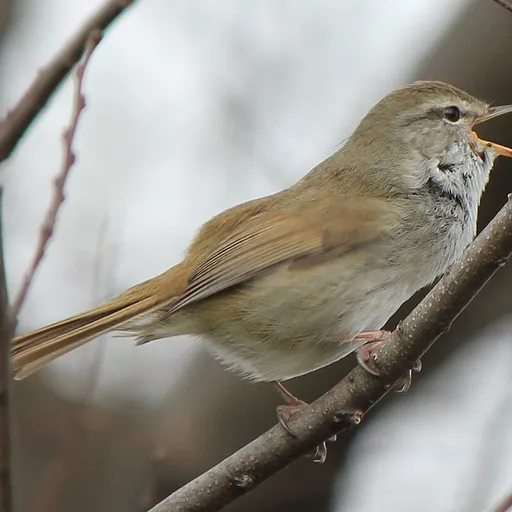
Japanese Bush Warbler
Horornis diphone
Least Concern
Listen
XC1177906 · steve · Nagano, Nagano, Japan · CC BY-SA 4.0
Overview
The Japanese bush warbler (Horornis diphone), known in Japanese as uguisu, is an Asian passerine bird that is more often heard than seen. Its distinctive breeding song can be heard throughout much of Japan from the start of spring.
Identification
- Typically 15.5 cm in length, with olive brown plumage above and dusky colours below.
- Features pale eyebrows and an upturned beak that gives the appearance of a smile.
- Recognised by its distinctive song, commonly described as 'Hooo- hokekyo, hooo- hokekyo'.
Habitat
A common year-round resident throughout Japan (except Hokkaidō) and the northern Philippines, with summer movements into Hokkaidō, Manchuria, Korea, and central China. It prefers bamboo thickets and black pine trees in summer at high elevations, seeking cover in lower elevations in winter. The species has also established a population in the Hawaiian Islands.
Did you know?
The name 'Japanese Nightingale' was historically used because of the beauty of its song, despite the fact that the bird does not sing at night like its European counterpart. The warbler's call is culturally significant in Japan, with the 'uguisu' serving as a haiku kigo for early spring and its call pattern being mimicked by the Nintendo Wii's message notification light.
Sources
- Wikipedia · CC BY-SA 4.0
- Wikidata · CC0 1.0