
Leach's Storm Petrel
Hydrobates leucorhous
Vulnerable
Listen
XC748107 · Doug Hynes · Country Island, Nova Scotia, Canada · CC BY-SA 4.0
Overview
Leach's storm petrel is a small seabird of the tubenose order, listed as Vulnerable on the IUCN Red List. It is a pelagic species that breeds on inaccessible islands in colder northern areas of the North Atlantic and North Pacific Oceans, with a single breeding colony in the Southern Hemisphere on Dassen Island in South Africa. The bird is named after the British zoologist William Elford Leach.
Identification
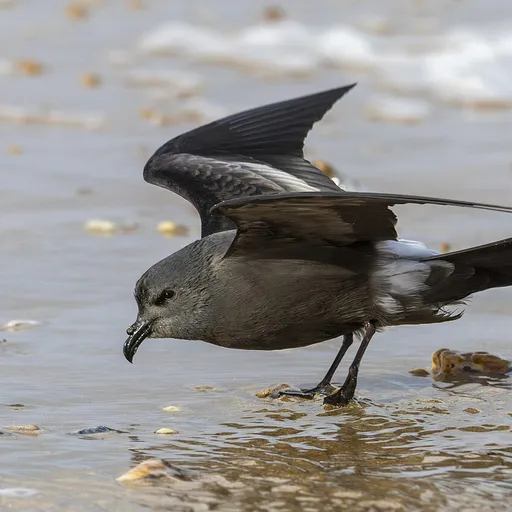
- Plumage: All-black with a paler grey-brown bar on secondary wing coverts, a slightly paler face, and usually a white rump with a dark divide down the middle; dark-rumped individuals are common in the Pacific.
- Size: Small, at 18–21 cm in length with a 43–48 cm wingspan.
- Markings: A white rump (in the Atlantic), distinguishing it from the European and Wilson's storm petrels; dark-rumped individuals can be confused with other all-dark species.
- Flight: Fluttering flight, with the bird patterning on the water surface to pick planktonic food.
Habitat
It is strictly pelagic outside the breeding season and breeds on remote, inaccessible islands in the colder northern areas of the North Atlantic and North Pacific Oceans, nesting in well-concealed locations such as rock crevices, shallow burrows, or even logs. The only breeding colony in the Southern Hemisphere is on Dassen Island in South Africa. In Europe, it is most likely to be seen in autumn in Liverpool Bay between north Wales and northwest England, where strong north-westerly gales funnel migrating birds into the area.
Diet
Feeds primarily on plankton, including euphausiids, copepods, and a form of amphipod parasitic on jellyfish gonadal pouches, as well as myctophids (lantern fish) that surface at night over the continental slope. Individuals forage on the ocean surface, patterning along to pick up food items, and can be observed feeding up to 1,000 km from their breeding colony. During the breeding season, they store energy-rich lipids in a sac anterior to the stomach to sustain themselves while incubating the egg or feeding the chick.
Did you know?
It has an unusually long lifespan for a bird of its size, averaging 13 years, with a maximum recorded lifespan of 38+ years. In 2003, it was found that its telomeres lengthen with age, the only known example of this phenomenon at the time.
Sources
- Wikipedia · CC BY-SA 4.0
- Wikidata · CC0 1.0