
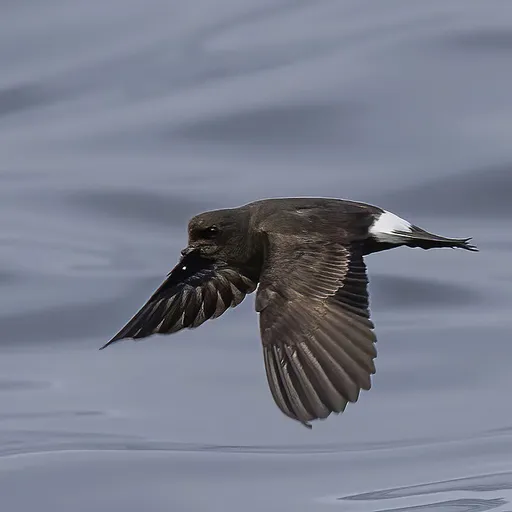
European Storm Petrel
Hydrobates pelagicus
Least Concern
Overview
The European storm petrel (Hydrobates pelagicus), also known as the British storm petrel, is a small seabird in the family Hydrobatidae that is entirely black with a distinct white rump. This strictly oceanic bird is strongly migratory, breeding on islands in the northern coasts of Europe and spending the Northern Hemisphere winter off the coasts of South Africa and Namibia. It is classified as Least Concern on the IUCN Red List due to its high total numbers, despite facing threats from introduced land mammals.
Identification
- A small bird, 14–18 cm in length, with all-black plumage (which can appear dark brown when worn) except for a broad, snow-white rump and a white band on the under wings.
- Characterised by a distinctive, weak-looking fluttering flight that resembles a bat, with short glides interspersed with fluttering, rather than the walking motion seen in Wilson's storm petrels.
- Features a square tail, and while it is usually silent at sea, it produces a chattering call in its display flight and a purring song from the breeding chamber.
Habitat
Breeding occurs exclusively in the Western Palaearctic on exposed, usually uninhabited islands off the Atlantic and Mediterranean coasts of Europe, including the Faroe Islands, United Kingdom, Ireland, and Iceland. During the non-breeding season, the bird is strictly oceanic, primarily occupying mid-depth waters off the coasts of South Africa and Namibia, though it rarely appears over ocean deeps.
Diet
The bird forages by pattering on the sea surface within 10 metres of the water, picking up small fish, squid, crustaceans, and jellyfish, and is capable of diving to depths of up to 5 metres. It uses a keen sense of smell to locate oily, edible items such as offal and follows ships to feed on fish or prawn leftovers from tuna farms.
Did you know?
The European storm petrel possesses large nasal olfactory bulbs that give it a keen sense of smell, allowing it to recognise its own body scent to locate nests in the dark. Its food is converted in the stomach into an oily orange liquid, produced by a large gland, which is regurgitated to feed the chicks.
Sources
- Wikipedia · CC BY-SA 4.0
- Wikidata · CC0 1.0